
Wimbledon Betting Markets Explained: Every Option Available to UK Punters
 Available in US
I’ve watched punters leave serious money on the table at Wimbledon not because they picked the wrong player, but because they picked the wrong market. Someone bets outright on a player they fancy at 14/1, that player reaches the semi-finals, and the bettor ends up frustrated because an each-way bet would have paid out. Someone else backs a match winner at even money, wins the bet, and doesn’t realise they could have found a better return through set handicap. The markets at Wimbledon are far more varied than they appear on a bookmaker’s front page, and knowing the mechanics of each one — what it pays, when it settles, and what the edge looks like — is the operational foundation of any coherent betting approach.
Tennis is now the fastest-growing sport in UK online betting, with a CAGR of 13.83% projected through to 2031. Live and in-play wagering alone accounts for 62.35% of all online sports betting volume. Wimbledon, as the only grass-court Grand Slam and a 14-day fortnight, sits at the centre of both trends. This guide covers every market available to UK punters: how each one works, how it settles, and the specific conditions under which it carries genuine value. It is an operational reference, not a list of names.
Outright Winner Markets: Men’s and Women’s Singles
The first time I placed an outright Wimbledon bet, I thought it was simple: pick the winner, collect if they lift the trophy. Two years in, I realised the outright market is actually a long-duration instrument with its own timing logic, risk structure, and settlement mechanics — and that most punters treat it like a simple match bet stretched over a fortnight.
Men’s Singles Outright
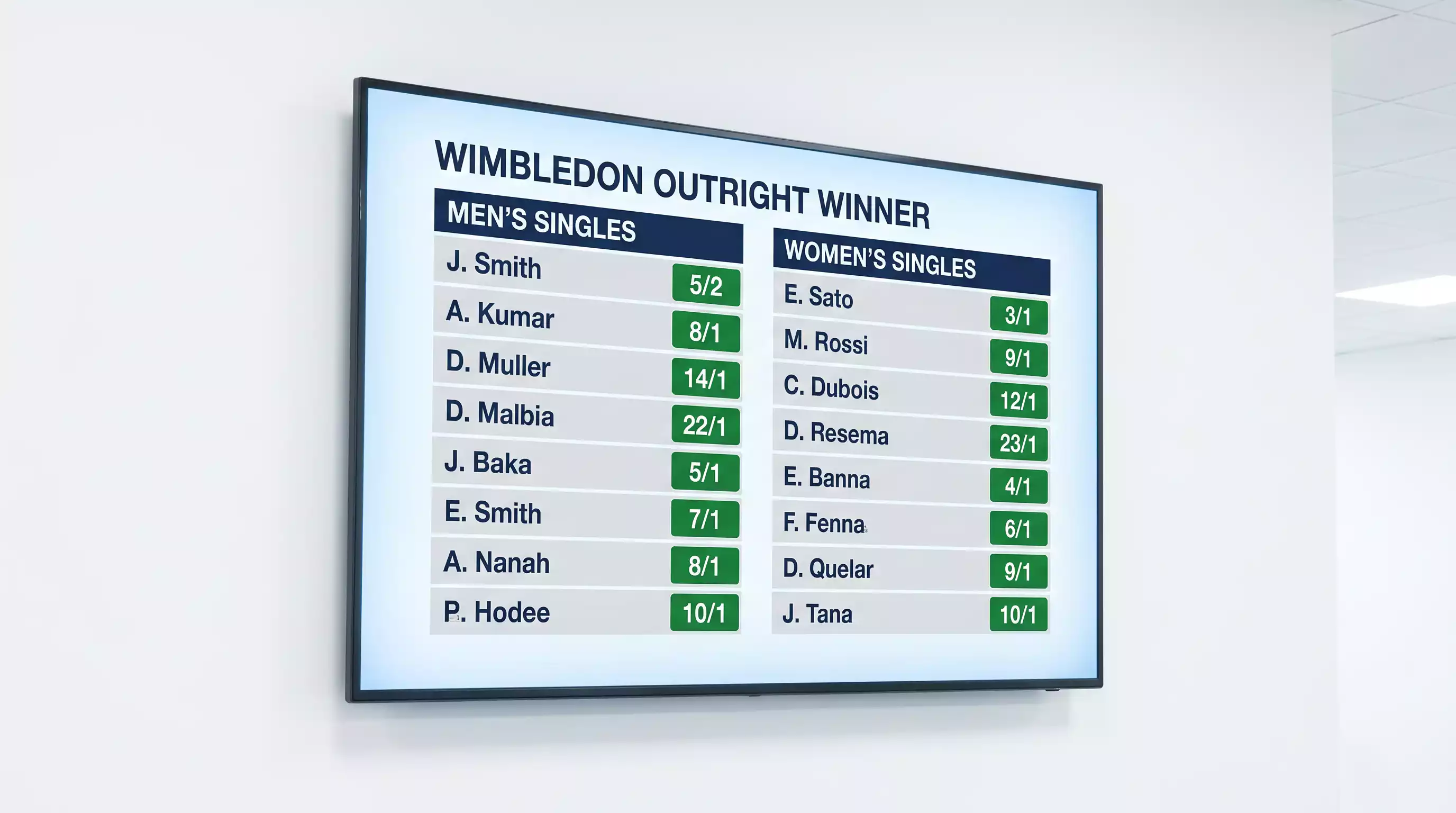
The men’s singles outright at Wimbledon is an ante-post market that opens as early as January and closes once the tournament begins. You’re betting on a player to win the title outright, and the bet settles only when the champion is crowned on the final Sunday. The key structural feature: if your selection withdraws before or during the tournament without playing a match, most UKGC-licensed bookmakers apply a “non-runner, no-bet” rule, meaning you get your stake back. Some do not — check the terms before you place.
The prizewinner mechanics matter for context. Wimbledon’s prize fund reached a record £53.55 million in 2025, a 7% increase on the previous year and exactly double the figure a decade ago. The men’s singles champion receives £3,000,000 — a figure that reflects the tournament’s commercial weight and keeps player motivation high even for already-wealthy draws. For a bettor, this translates into reduced withdrawal risk from top players: the incentive to compete is substantial at every round.
Ante-post odds in men’s Wimbledon historically compress as the tournament approaches. A player attracting significant backing after Queen’s Club will see their price shorten from 8/1 to 5/1 in the fortnight before the draw. The most efficient window for value-seeking outright punters tends to be after the grass-swing results (Queen’s Club, Halle) but before the Wimbledon draw is announced — at that point, the field is roughly knowable but draw-position uncertainty still inflates prices on genuine contenders.
Women’s Singles Outright
The women’s singles outright operates on the same ante-post mechanics but with a structurally different probability distribution. The women’s draw at Wimbledon has historically produced more varied winners — unseeded or low-seeded finalists appear more frequently than in the men’s event — which means the outright market is wider and each-way value is more consistently present. Where the men’s market might compress to a handful of realistic contenders within the top eight seeds, the women’s draw regularly features semi-finalists who entered the tournament at 25/1 or longer.
Player form on grass matters just as much on the women’s tour, but the sample of grass-court events is thinner: fewer WTA 250 and WTA 500 events are played on grass before Wimbledon compared to the ATP calendar. This creates more uncertainty in pricing and, correspondingly, more inefficiency in outright markets. For the analytically minded punter, the women’s draw consistently offers a better ratio of potential return to genuine probability than the men’s.
Match Betting: Picking a Winner Round by Round
Match betting is where most Wimbledon volume sits. You pick one player to beat another in a specific match, and the bet settles when the match concludes — straightforward in structure but deceptively complex at Wimbledon because of how grass-court dynamics interact with seedings and early-round matchups.
The trap in rounds one and two is treating ATP or WTA rankings as if they directly map to grass performance. They do not. A clay-court specialist ranked 12th in the world who has just played a deep run at Roland Garros may be physically and technically unprepared for the pace of SW19. Against a 45th-ranked player with a serve-dominant game and solid grass-court record, that 12th seed is not a safe favourite at 1/3. The match betting market often prices this correctly by the time the tournament starts, but not always. Survey data from the 2025 YouGov/OLBG study found that 37% of UK Wimbledon bettors rank player form as their primary decision factor — but only 12% prioritise grass-specific statistics. That gap is where match betting value can be found.
Set Handicap and Game Handicap
Set handicap betting applies a virtual advantage or disadvantage to one player measured in sets. If you back Player A at -1.5 sets on set handicap, they need to win 3-0 (in the best-of-five men’s format) or 2-0 (in the women’s best-of-three) for your bet to win. This pays at higher odds than straight match betting — typically 5/4 or 6/4 where the match price might be 1/4 — in exchange for requiring a dominant performance.
Game handicap operates at a finer granularity, applying a line across total games in a match. A bet on Player A -4.5 games requires them to win more total games, including the handicap, than their opponent. In a 6-3, 6-4 result, Player A wins 12 games to their opponent’s 7 — a margin of 5, which covers -4.5. Game handicap markets are less commonly offered than set handicap but tend to have lower overrounds on tight matches because they’re harder to price efficiently.

Both handicap formats carry extra value at Wimbledon when serve dominance is extreme. A match between two heavy servers — where breaks of serve are genuinely rare — is more likely to produce lopsided set scores driven by a single service break than a hard-court match of equivalent competitive standing. This tilts probability toward the favourite covering set handicap more often than standard match-winner odds imply.
One pattern I’ve tracked consistently: in men’s first and second rounds at Wimbledon, the match price on top-eight seeds against qualifiers or low-ranked opponents often reaches 1/8 or shorter, making straight match betting commercially unappealing. Set handicap at -1.5 sets for the same selection, paying 4/6 or 8/11, frequently represents the same underlying probability at a return structure that makes the transaction worth executing. The caveat is injury risk: at short set-handicap prices, a retirement or withdrawal that triggers a walkover settlement can leave you with a losing bet on an outcome your analysis correctly predicted.
Set Betting and Correct Set Scores
One of the genuinely underused markets at Wimbledon. I’ve seen experienced punters dismiss set betting as a novelty, which tells me they haven’t spent time on the actual probability distribution. Set betting at Wimbledon — particularly in men’s singles — has structural features that create exploitable gaps in bookmaker pricing.
Set betting asks you to predict the exact scoreline in sets: will the match end 3-0, 3-1, or 3-2 for the favourite, or 3-0, 3-1, or 3-2 for the underdog? Each outcome has a different price, and the combined overround across all outcomes is typically lower than on match betting markets — particularly when you concentrate on the most likely scenarios. On grass, where serve dominance compresses rallies and reduces break opportunity, the probability of a dominant 3-0 victory by a serve-heavy favourite is meaningfully higher than on clay. Bookmakers, calibrating odds across surfaces, often under-price this.
Correct set score betting takes this a step further and prices individual set scores within a match — 7-5 in the first, 6-3 in the second, and so on. These odds are long — often 20/1 and beyond — but the payouts on a matched sequence are substantial. The practical value here is not as a primary market but as a supplement: if you’ve done the analysis for match betting and set betting, correct set scores add a high-upside layer without requiring additional research.
The important distinction between “set betting” and “correct score” at most UKGC bookmakers: set betting settles on the number of sets each player wins, regardless of the scores within each set. Correct score settles on the precise game score (6-4, 7-5, etc.) within each set. This seems obvious but causes settlement disputes when punters conflate the two. Read the market definition before placing.
Each-Way Betting at Wimbledon: When It Offers Real Value
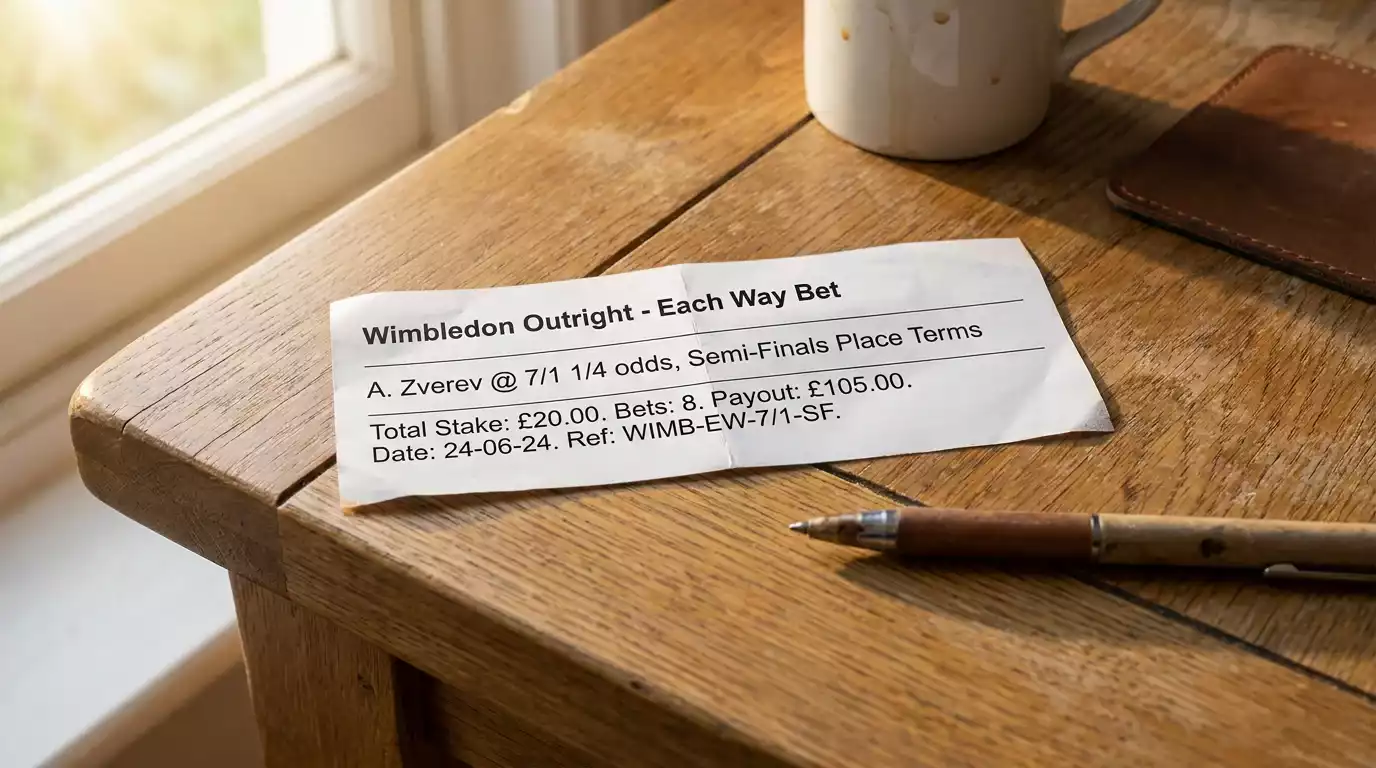
Each-way betting at Wimbledon outright markets is structurally different from each-way betting on horse racing, and the difference matters. In racing, “place” terms are standardised by race type. In Wimbledon outright betting, the terms vary by bookmaker and are set entirely at their discretion — typically paying a fraction of the win odds (commonly 1/4 or 1/5) for a player reaching a specified round, most often the semi-finals or the final.
The arithmetic of each-way value at Wimbledon depends on three variables: the place fraction, the number of places paid, and the player’s actual probability of reaching the paid position. When those three align in your favour, an each-way bet on a 25/1 shot paying 1/4 odds for semi-finals offers returns that a straight outright on the same player cannot match on a risk-adjusted basis.
The most consistent each-way value at Wimbledon appears in two scenarios. First: the women’s draw, where unseeded or low-seeded players reach the final four often enough that the place part of an each-way bet is genuinely reachable at 25/1 or longer. A player at 33/1 who has a realistic 15-18% chance of reaching the semi-finals should, on those probabilities, be a value each-way proposition if the bookmaker is paying 1/4 for semi-finals. Second: male unseeded players with strong serve games and demonstrated grass performance, who can navigate early rounds against over-ranked opponents and achieve a run to the last eight at odds that reflect their overall ranking, not their grass-specific ability.
Richard Moffat at OLBG observed that what distinguishes sharper Wimbledon bettors is “a statistically grounded approach” — and each-way betting is precisely where that approach diverges most sharply from the general punting population, who mostly bet outright without comparing place terms across bookmakers. For more on how grass-court surface characteristics affect player probability, see the grass court tennis betting strategy analysis.
Ante-Post Wimbledon Odds: Timing Your Bet Before the Draw
Ante-post betting on Wimbledon is the art of pricing risk across time as well as probability. Every week between January and the draw announcement, the market absorbs new information: injury news, early-season results, withdrawal announcements, fitness updates. The price you get in March for a specific outright selection reflects February’s knowledge; the price available in late June reflects almost everything except draw position.
The structural question for ante-post punters is: where in the calendar does the information curve most reliably produce mispricing? My experience over nine years of tracking Wimbledon markets suggests the pattern holds reasonably consistently. In January and February, prices are notional — bookmakers are setting lines based on the previous year’s rankings and fitness assumptions, and volatility is high. The market becomes meaningfully more efficient after the clay season concludes in late May, when form on clay tells you something about physical condition (if not directly about grass performance), and after Queen’s Club and Halle results in June, when grass-specific form is confirmed.
The optimal ante-post window for most outright selections is therefore the 10-14 days after Queen’s Club and Halle results are known but before the Wimbledon draw is announced. At this point, prices have adjusted for form but not for draw position — a player like the second seed who could face the first seed in the semi-finals (as opposed to the quarter-finals) carries higher value if you’ve placed before the draw makes that scenario explicit. Post-draw, prices re-price to reflect draw sections, and the post-draw window closes within hours for active markets.

The non-runner risk in ante-post Wimbledon markets is real but manageable. Most UKGC-licensed bookmakers operate some form of non-runner, no-bet rule on Wimbledon outrights — meaning if your selection withdraws before playing a match, your stake is returned. However, “playing a match” varies in definition: some operators require the player to complete at least one set; others require only that they appear on court. Verify the exact wording before placing a long-odds ante-post selection on a player with a known injury history going into the grass swing.
Cash-out in ante-post markets is available at most major bookmakers but not all. If you hold an ante-post position on a player whose price has shortened significantly — say, you backed at 14/1 and they’ve moved to 5/1 after winning Queen’s Club — the cash-out function allows you to lock in a profit or reduce liability before the tournament starts. The offered cash-out price will be lower than the theoretical fair value, as the bookmaker takes a margin on the early settlement, but it is a useful tool when your ante-post conviction no longer matches the evidence.
Bet Builder and Same-Game Multi at Wimbledon
Bet Builder — or Same-Game Multi, as some bookmakers brand it — allows you to combine multiple selections from a single match into one bet. The combined selections must all come true for the bet to win, and the odds multiply to produce a return that a single-market bet cannot match. The appeal is obvious. The mechanics require careful attention.
At Wimbledon, a typical Bet Builder might combine: Player A to win the match, Player A to win the first set, and total aces in the match to be over 28.5. If all three outcomes happen, the bet wins at combined odds that might be 8/1 on a market where the individual win-match price is 1/4. The return is attractive; the correlation structure between the selections is what bookmakers rely on to price this profitably for themselves.
The correlation problem in tennis Bet Builders: selections are not independent. A player winning the match and winning the first set are positively correlated — the same player being dominant explains both. Bookmakers price for this correlation, reducing the combined odds below the mathematically naive product of the individual prices. A 1/4 match winner and 1/3 first-set winner would, naively, combine to roughly 1.25 x 1.33 = 1.67 (roughly 2/3). In a correlated Bet Builder, the combined price will be lower.

The selections with the least correlation to match outcome — and therefore the most “honest” pricing in a Bet Builder — are statistical markets: total aces, total double faults, number of tiebreaks. Combining a statistical selection you have genuine conviction on with the match winner can produce better value than combining two directionally identical selections. Not all bookmakers offer Bet Builder on tennis, and among those that do, not all offer Bet Builder on Wimbledon specifically. Availability varies by operator and by round — Bet Builder is most consistently available on Centre Court and No. 1 Court matches.
Doubles and Mixed Doubles Markets
The doubles and mixed doubles markets at Wimbledon are the least discussed and, in certain conditions, the most inefficient. I don’t lead with doubles betting in conversation because the liquidity is thin and the publicly available data on doubles-specific form is substantially worse than on singles. But for a punter willing to do the groundwork, the pricing inefficiency is real.
Doubles markets at Wimbledon are available on outright winner, match betting, and — at some bookmakers — individual set scores. Liquidity concentrates on the outright market; match betting in doubles rounds is offered by fewer operators and often with lower maximum stakes. The overround on doubles outright markets tends to be higher than on singles — bookmakers compensate for their own pricing uncertainty by building in a larger margin. This cuts both ways: it means worse value on average, but also means that a punter with genuine doubles-specific knowledge can find larger pricing errors than in the tightly scrutinised singles market.

Mixed doubles, the most unpredictable of the three disciplines, has the thinnest market of all. At major bookmakers, mixed doubles outright markets are available but settlement rules and market depth vary. The practical advice: treat mixed doubles betting as speculative, keep stakes proportionally small, and prioritise pairs where both players have strong current Wimbledon form in their singles draws — form on the grass surface is a more reliable predictor in mixed doubles than in any other element of preparation.
Articles




Written by the editors at bettingonwimbledontennis.
