
Wimbledon In-Play Betting: How to Read Grass-Court Momentum in Real Time
 Available in US
The first live bet I placed at Wimbledon was on a player who had just won the opening set 6-0. The odds were short — 1/4 to win the match — and I thought I was locking in a near-certainty. The player lost in five sets. I hadn’t understood that a 6-0 opening set at Wimbledon doesn’t predict the rest of the match the way it would on clay: the opponent hadn’t capitulated, they’d simply been broken by a surface that wasn’t playing to their strengths, and once they adjusted — tightened the serve, reduced rally length — the momentum reversed completely. That match was an expensive education in how live betting on grass requires a different interpretive framework than any other surface.
Live and in-play betting accounts for 62.35% of all online sports betting volume in the UK market. Tennis, specifically, is the fastest-growing betting sport, with a projected CAGR of 13.83% through 2031. The in-play dimension of that growth is driven in part by Wimbledon’s 14-day format, which offers a sustained fortnight of high-interest live betting opportunities. Understanding how grass-court momentum works — and how bookmaker odds respond to it — is the operational foundation of profitable in-play wagering at SW19.
Why Grass Courts Make In-Play Markets Uniquely Volatile
At Wimbledon, a single service break can be the difference between a 7-5 set and a 6-3 set. On clay or hard courts, if a player breaks serve at 4-4, the broken player can break back more easily in the next game because rally-based exchanges are more frequent and the server’s advantage is less extreme. On grass, a service break at 4-4 often seals the set because holding the subsequent service game is easier for the player who just broke — they serve to close with the momentum of a break behind them.
This creates a specific in-play dynamic: the probability of winning a set changes more sharply at Wimbledon than on other surfaces when a break of serve occurs. The live odds market has to respond to this larger probability shift, but there is a lag between the on-court event and the odds update. Bookmakers processing in-play markets have sophisticated algorithms, but the algorithms are calibrated on historical data from multiple surfaces. At Wimbledon specifically, the break-of-serve consequence is larger than the algorithm’s surface-averaging suggests — and this is where in-play value can be found in the seconds after a break point converts.

Unibet’s official commentary on Wimbledon describes it precisely: “fast serves, short rallies and unpredictable results make it an ideal event for bettors.” That unpredictability is not uniformly distributed across a match. It concentrates at service breaks, tiebreaks, and the start of each set — the moments when momentum on grass is most volatile and the pricing lag between event and odds is most pronounced.
Which In-Play Markets Move Fastest at Wimbledon
Not all live markets at Wimbledon respond equally to on-court events. Understanding the market-specific response velocity tells you which instrument to use for a given timing opportunity.
Next Game Winner
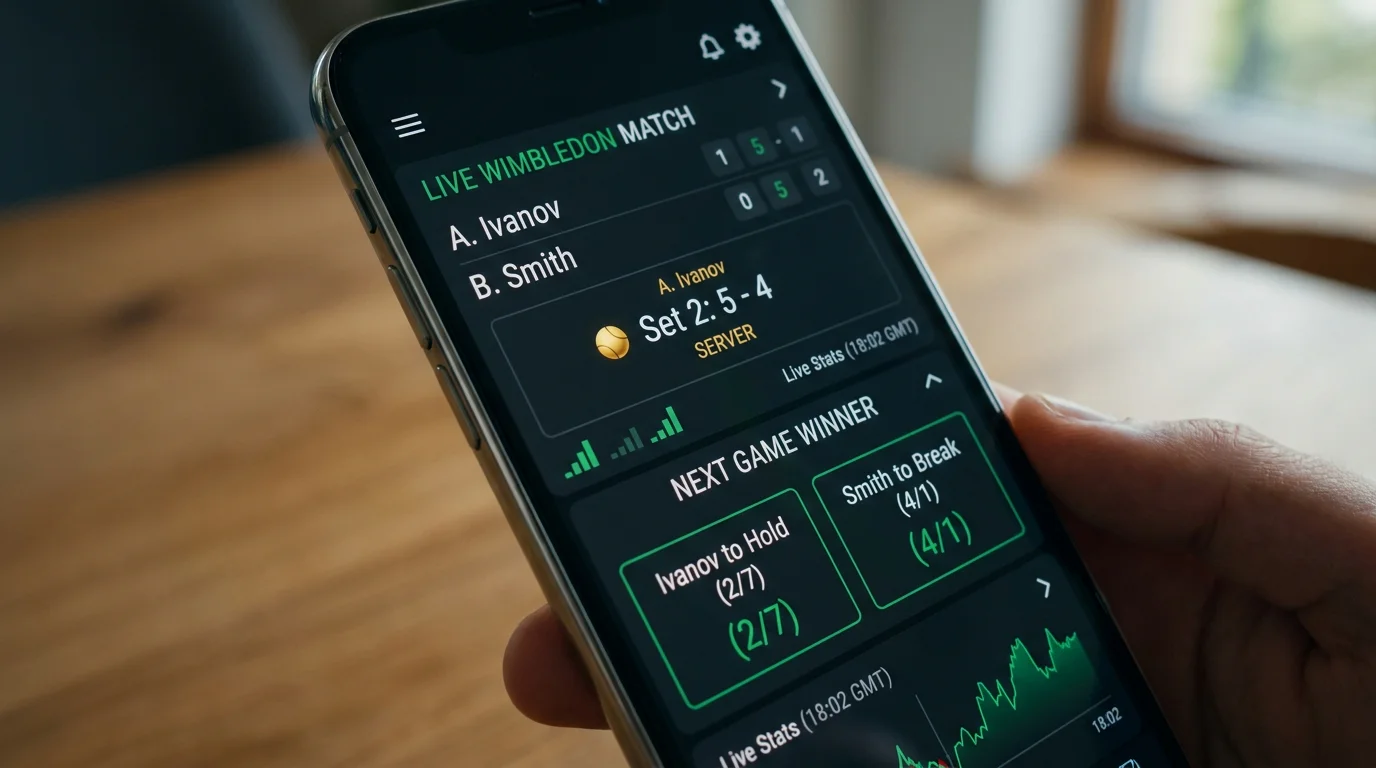
The next game winner market is the most liquid in-play offering at Wimbledon and responds most immediately to serve information. Within a game, after a double fault, a break point or a service winner, the odds on the current game outcome update in near real-time. The pre-game odds — set before the first serve — are the most stable and therefore the most efficiently priced. The value window opens when a rally within a service game changes the situation: a 0-30 score against a heavy server, for example, creates a break point probability that the static pre-game odds don’t fully reflect.
Set Winner In-Play
The set winner market prices change most significantly at break-of-serve moments. If the set is at 4-4 and a break occurs, the set winner market shifts immediately — but the magnitude of the shift at Wimbledon is often larger than the initial odds imply because of the serve dominance dynamic described above. A break at 4-4 on grass represents a higher conditional probability of winning the set than the same break on hard courts, and live algorithms that draw on cross-surface averages tend to under-price this.
The value in set winner in-play betting at Wimbledon is most consistently available in the period immediately after a break is confirmed and before the serving player holds in the next game. In those 90-120 seconds, the market is settling from the break shock; if the newly broken player is a consistent server, the live set winner price may still be at a level that under-reflects the probability that the player who broke goes on to hold.
Match Winner Live
Match winner in-play markets at Wimbledon undergo their sharpest adjustment at two points: after the first set concludes, and mid-second-set when a break has occurred. The first set at Wimbledon is a genuine predictor of match outcome — partly because of the mental impact of winning a set cleanly, and partly because it reveals serve-return dynamics that are more informative on grass (where returns are harder to execute) than on other surfaces. A player winning the first set 6-3 against a tough opponent has demonstrated both serve quality and return quality; the live market adjustment after the first set will be significant but is often not large enough to eliminate the remaining value in the winner market.
When to Enter an In-Play Bet: Timing Windows on Grass
Timing is the most critical and least documented aspect of in-play Wimbledon betting. The abstract answer — “enter when the live odds are better than the true probability” — is tautological. The practical answer requires identifying specific timing windows when the probability and the live price consistently diverge.
The most reliable timing window I’ve identified over years of Wimbledon in-play work: entering the match winner market in favour of the first-set loser, at the start of the second set, when the following conditions apply simultaneously. First, the first-set loss was by a narrow margin — 7-6 or 7-5, not 6-2. Second, the loser had a higher first-serve percentage in the first set than their opponent. Third, the loser’s grass-court record is equivalent to or better than their opponent’s. Under these conditions, the first set outcome has caused an over-correction in the live match winner price, and the underlying probability distribution has not shifted as much as the odds suggest.

A second consistent timing window: in the third set of a women’s match (or the fourth set of a men’s match), at 4-4, when the player who has been behind throughout the match holds serve to make 4-4. The live market will have them as a significant underdog — their overall position in the match supports this — but the specific moment of 4-4 in a deciding set, with serve coming up, creates a conditional probability scenario that is closer to 50-50 than the overall match narrative implies. The live odds frequently lag this reality by 10-15 percentage points at this specific moment.
Weather conditions and the Centre Court roof are significant modifiers. When play moves under the roof — either because of rain or because the late-evening light is failing — the playing conditions change materially. The roof at Wimbledon effectively converts the grass surface to a slightly faster hard-court equivalents — the bounce becomes more predictable, humidity drops, and serve dominance increases. A player with a strong serve who is struggling slightly on the outer courts in humid outdoor conditions will perform better under the roof. In-play odds at the moment of the roof closure take a few games to adjust to the new serving conditions; those first two or three service games under the roof are the most mispriced moment in a covered-play session.

Cash-Out at Wimbledon: Full, Partial and Auto Cash-Out
Cash-out during Wimbledon is a tool — like any tool, it produces good outcomes when used appropriately and poor outcomes when used reflexively. The decision to cash out a Wimbledon in-play bet should be a deliberate calculation, not an emotional response to match pressure.
Full cash-out settles your entire position at the current offered price. The bookmaker offers you a cash settlement that reflects their current assessment of the remaining probability, minus their margin on the early settlement. Full cash-out makes sense when your analytical view of the match has changed — not because you’re nervous, but because new information (a visible injury, a significant tactical adjustment, a retirement announcement that hasn’t been confirmed yet) has changed your probability assessment.
Partial cash-out is more versatile. You settle a proportion of your stake — say, 60% — and leave 40% running. This locks in a partial profit or limits liability on the portion settled, while maintaining exposure to the upside if your selection continues to perform. For a pre-match outright position on a player who has reached the Wimbledon quarter-finals, a partial cash-out at the round of 16 secures some return while keeping you in the position for the remaining rounds. The offered price for the partial settlement will be at the bookmaker’s margin, but the instrument itself is sound.
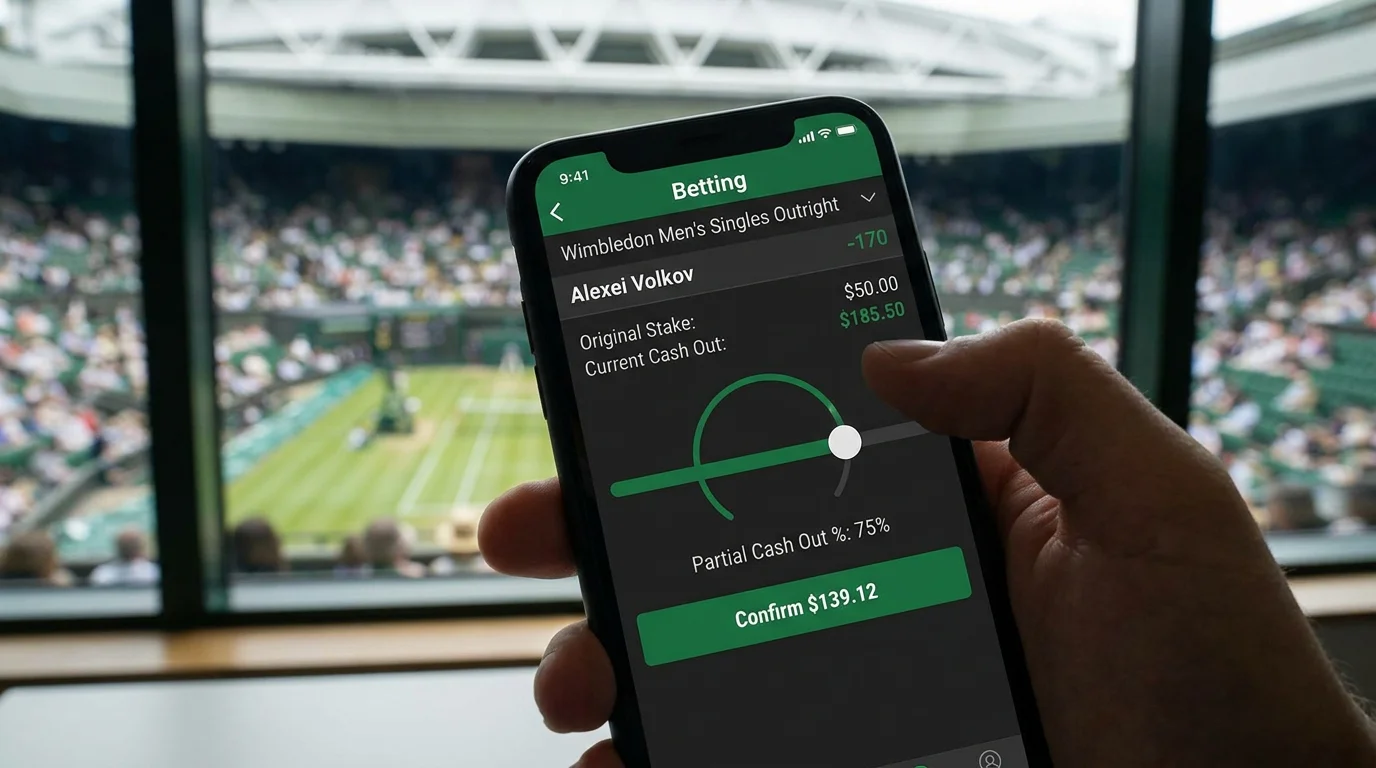
Auto cash-out allows you to set a threshold — “settle at £150” — and the system executes automatically when the offered cash-out value reaches that amount. This is most useful for ante-post positions where you know in advance what level of return satisfies your risk requirements and don’t want to monitor the market continuously. For in-play bets on specific matches, auto cash-out is less useful because the timing of the threshold is as important as the threshold itself — a static level doesn’t account for the dynamics of the specific match situation.
Survey data indicates that typical UK Wimbledon punters stake between £5 and £50 per bet. At these staking levels, the practical value of sophisticated cash-out management is real: the difference between a full cash-out at 60% of potential return and a partial cash-out followed by a winning settlement is a meaningful percentage of total tournament outlay for most recreational punters.
Choosing an In-Play Platform for Wimbledon: What Actually Matters
Platform selection for in-play Wimbledon betting is not interchangeable. The specific functional requirements of live betting — speed, accuracy, navigation efficiency — vary significantly between bookmakers, and the variance directly affects your ability to execute in-play entries at the timing windows identified above.
Latency is the most important technical criterion. Latency is the delay between a real-world event (a double fault, a serve ace, a break point conceded) and the odds update on your screen. A platform with 3-second latency means you have 3 seconds to place a bet after seeing an event that changes the probability — before the odds adjust. A platform with 12-second latency means you may see a break of serve, watch the odds begin to move, and be unable to place the entry before the adjustment completes. On a surface where a single break changes the match dynamics as significantly as Wimbledon’s does, latency differential between platforms is a meaningful competitive variable.
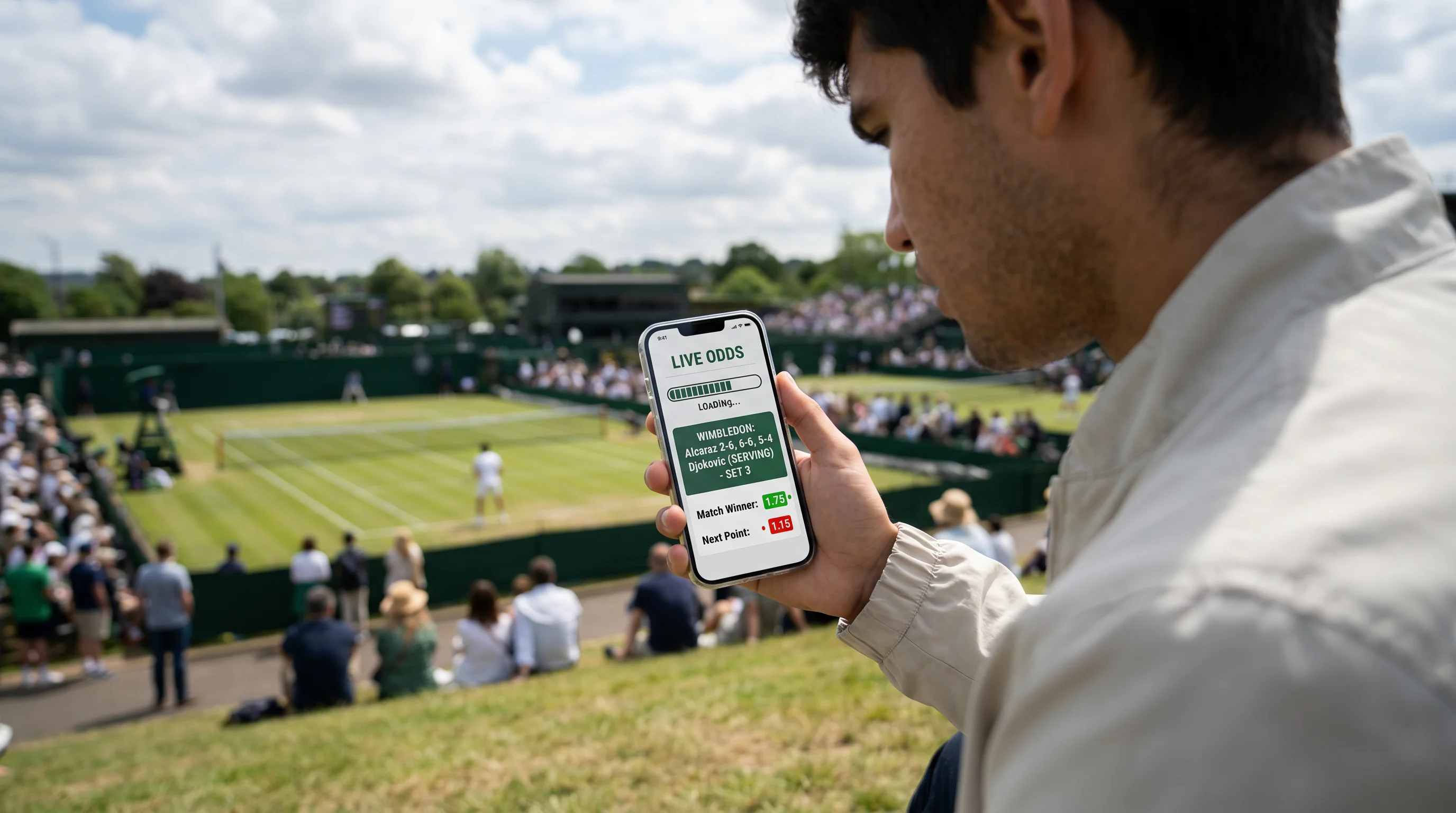
Visualisation quality — a live court graphic showing real-time score, server, and recent points won — allows you to track match dynamics without relying on live television or secondary data sources. At Wimbledon, where multiple matches on outer courts run simultaneously, visualisation means you can monitor more markets at once and identify timing opportunities across several matches rather than only the one you’re watching.
Online betting now accounts for 78.47% of the UK sports betting market by revenue, and 10% of all UK adults are active online sports bettors. The mobile UX quality of in-play platforms has improved substantially as operators have responded to this shift. For Wimbledon in-play betting specifically, the number of navigation steps between the live match screen and bet confirmation is the single most practical UX metric: a platform where placing a live bet requires four taps instead of two will cost you entries when the timing window is narrow.
Four In-Play Mistakes UK Wimbledon Punters Make — and How to Avoid Them
After nine years of watching in-play markets at Wimbledon, these are the four mistakes I see consistently.
Chasing momentum is the first and most common. A player wins three games in a row — the last one with a clean ace — and it feels like they’re inevitably going to win the set. On grass, momentum is more fragile than it appears: a single hold of serve by the opponent at 15-30 resets the psychological dynamic and changes the conditional probability of the set outcome without the market adjusting significantly. In-play bettors who enter after a run of consecutive games won are often entering at the worst possible moment in terms of odds-to-probability ratio.
Ignoring server statistics is the second mistake. Entering an in-play bet based on scoreline alone — “he’s up 4-2, the price looks good” — without knowing the server’s first-serve percentage and service points won in that specific match leads to misjudged entries. A player up 4-2 with a 52% first-serve rate is in a more fragile position at Wimbledon than a player up 4-2 with a 72% first-serve rate, even if the scoreline looks identical.
Over-reliance on overall score rather than set-level analysis is the third. A player losing 1-2 in sets who just held comfortably to make it 4-4 in the fourth set is in a different probabilistic position from a player losing 1-2 who is being broken at 3-5. The overall score is the same; the set-level context is entirely different. In-play markets at Wimbledon price both situations similarly when they shouldn’t.
Betting into momentum just before a changeover is the fourth. When players switch ends after every odd-numbered game, there’s a natural pause in play. In the last game before a changeover, particularly when a service game is under pressure, the live market tends to over-react to points as they develop. The odds on the current game winner swing dramatically on individual points in a way that doesn’t fully account for the serve dominance dynamic. The best in-play entries come after the changeover, when the market has settled from the previous game’s volatility.
Reading the Market Before Your Next Wimbledon Match
Every in-play bet at Wimbledon is the outcome of three overlapping assessments: what the surface is doing to the match (surface-specific form is more important here than anywhere else), what the bookmaker’s pricing algorithm is doing relative to the true probability (the lag I’ve described above), and what the match dynamics are actually telling you in this specific fortnight, this specific draw, this specific weather context. None of these operates independently, and none of them can be assessed reliably from the scoreline alone. The punter who understands the grass-court mechanics outlined in the grass court tennis betting strategy guide will consistently enter in-play markets from a better-informed position than one who treats Wimbledon as just another tennis event with the volume turned up.
Articles


Written by the editors at bettingonwimbledontennis.
