
Each-Way Betting on Wimbledon: Value Assessment for UK Punters
 Available in US
The each-way bet is one of the most misunderstood instruments in tennis betting, partly because it migrated from horse racing where it originated, and partly because most punters reach for it instinctively without doing the maths. A 2025 YouGov survey found that most UK Wimbledon bettors stake between £5 and £50 per bet — sensible, modest amounts — but the question is not how much they stake but whether the structure of the bet represents genuine value. Each-way betting on Wimbledon outrights can deliver exceptional returns when used correctly, but it can just as easily halve your effective odds if you pick the wrong market terms. The difference lies in spending two minutes on the calculation before you place it.
How Each-Way Bets Work on Wimbledon Outright Markets
An each-way bet is two bets in one: one bet on your selection to win the tournament, and one bet on your selection to “place” — meaning to finish within a specified number of places, as defined by the bookmaker’s terms for that market. Each part of the bet is for the same stake, so a £10 each-way bet costs £20 total (£10 win + £10 place).
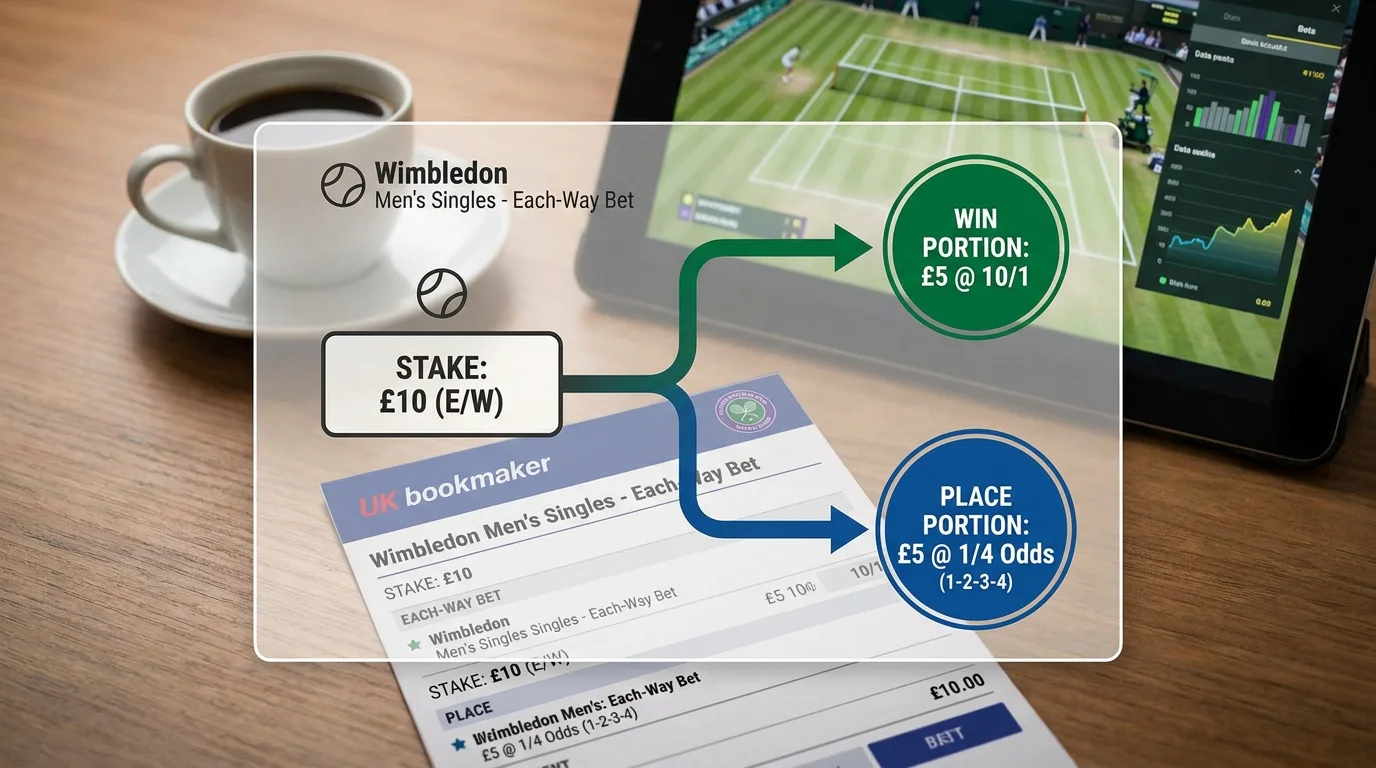
The place part of the bet is paid at a fraction of the win odds. The most common fractions on Wimbledon outright markets are 1/4 and 1/5. If you back a player each-way at 20/1 and the bookmaker’s terms are 1/4 odds for four places, and your player reaches the final four but does not win: the win part of your bet loses, but the place part pays at 20/1 divided by 4 = 5/1. On a £10 place stake, that is £50 profit plus your £10 stake returned — a £60 total return on the place portion, offset by the £10 loss on the win portion, for a net profit of £50 on a £20 total outlay.
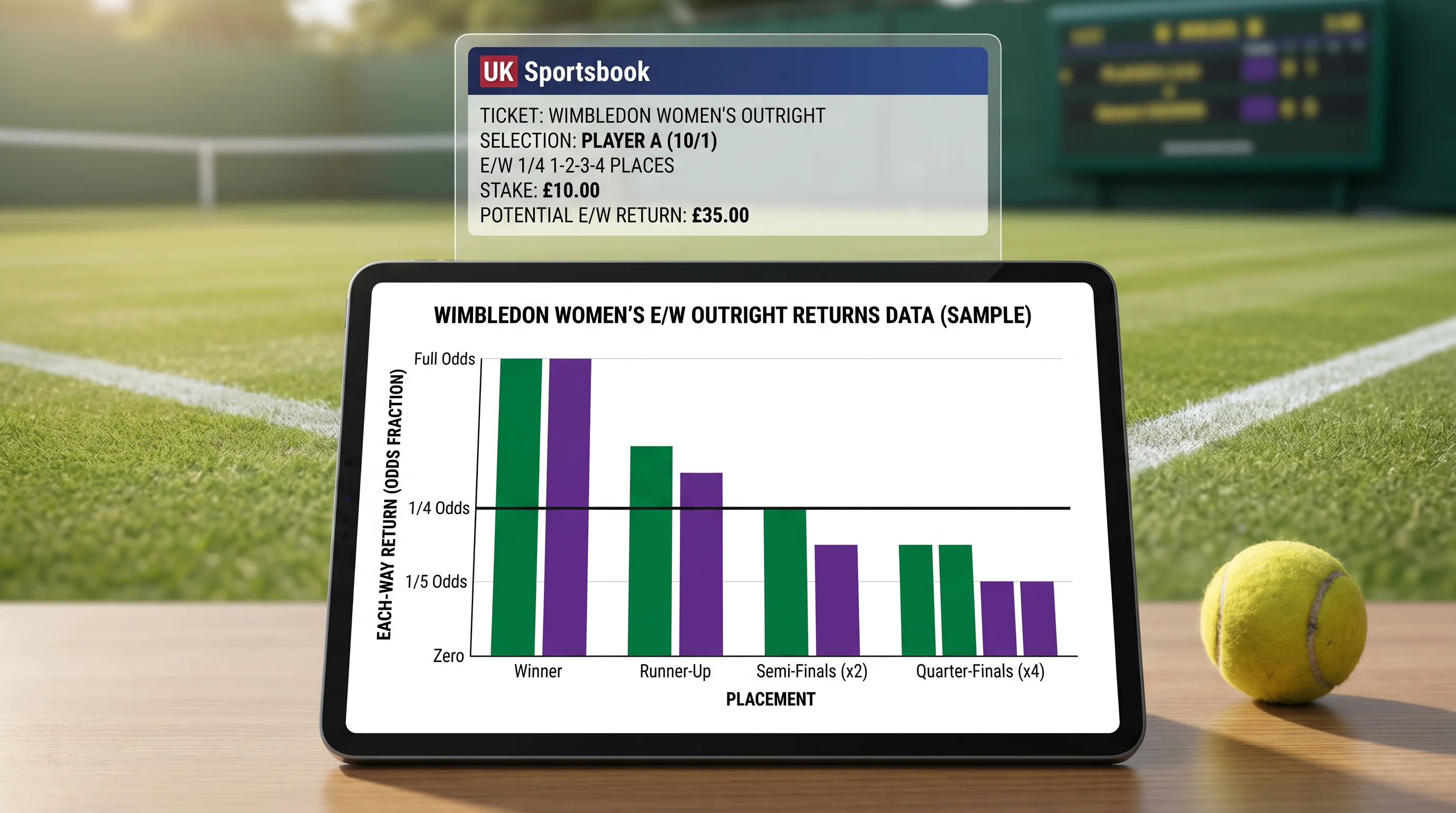
This structure is powerful in Wimbledon because the tournament has a defined set of positions: winner (1st), finalist (2nd), and two semi-finalists. A four-place each-way bet essentially asks: will your player reach the semi-finals? On a draw of 128 players, reaching the semi-finals requires winning five consecutive matches. In a wide-open women’s draw, several players in the 12/1 to 20/1 range have genuine semi-final prospects. In the men’s draw, the same applies for players in the 8/1 to 14/1 range who have strong grass-court credentials.
Place Terms at Wimbledon: How Bookmakers Differ
This is where the devil lives. Place terms on Wimbledon outright markets vary significantly between operators, and the difference between a three-place and four-place market — or between 1/4 and 1/5 fractions — can change whether a specific each-way bet has positive or negative expected value.

The typical range at major UK operators for Wimbledon singles outright markets: three to four places, at a fraction of either 1/4 or 1/5. Some operators offer a premium during the tournament launch period — occasionally extending to five places with 1/4 odds — which represents genuinely better terms that are worth noting and acting on quickly before they revert to standard.
How to compare: take the place part of the bet in isolation. If Operator A offers 1/4 odds for four places on a player at 14/1, the place part pays at 14/4 = 3.5/1 (or 4.50 decimal). If Operator B offers 1/5 odds for three places on the same player at 14/1, the place part pays at 14/5 = 2.8/1 (or 3.80 decimal), and you need to reach top three rather than top four. Operator A is significantly better — both a higher fractional return and an easier target.
Before placing any Wimbledon each-way outright bet, the minimum checklist is: confirm the number of places, confirm the fraction, and compare at least two operators. Fifteen minutes of comparison at the start of each tournament fortnight can meaningfully affect your returns over a season.
When Each-Way Beats a Straight Win Bet at SW19
Only 7% of UK bettors wager on tennis throughout the year; 22% bet exclusively at the four Grand Slams. This seasonal concentration means the Wimbledon outright market attracts significant recreational money, which tends to compress the prices of well-known players and inflate the prices of less-publicised contenders. That dynamic creates the specific conditions where each-way betting on second-tier players generates the best value.

The mathematical condition for each-way value is: the player’s true probability of reaching the “place” threshold should exceed the implied probability of the place part of the bet at the offered fraction. Put concretely: if you believe a player at 16/1 has a 20% chance of reaching the Wimbledon semi-finals, and the bookmaker is offering 1/4 odds for four places, the implied probability of the place part is 1 / (1 + 4) = 20%. You are at fair value. If you believe the player has a 25% chance of the semi-finals, the each-way bet has genuine value. If you believe the chance is 15%, the each-way bet has negative value for the place portion despite the attractive headline odds.
The each-way structure is most clearly superior to a straight win bet when a player has a high probability of a deep run but uncertainty about whether they can win the title itself. A player I might assess as 20% semi-final / 8% final / 4% champion represents different each-way value than a player I assess as 10% semi-final / 8% final / 6% champion — even if their outright prices are identical. The first player is an excellent each-way candidate; the second is better backed to win.
Three Each-Way Mistakes Wimbledon Punters Make
The first mistake is assuming each-way is always better value than straight win. It is not. When a player’s probability is concentrated at winning rather than placing — a top-three seed with realistic title contention but limited value as a semi-finalist given their likely quarter-final opponent — the each-way structure costs you because the place part of the bet is expensive insurance you do not need.

The second mistake is not checking place terms before betting. I have seen punters back the same player each-way at two different operators simultaneously, not realising one was offering three places and one was offering four. The difference on a significant outright position can run to tens of pounds on a single tournament.
The third mistake is treating each-way as a way to reduce anxiety rather than as a structured value bet. “I like this player but I’m worried they might not win, so I’ll go each-way” is not a strategy — it is hedging for emotional reasons. Each-way should be chosen because the mathematics support it: the place probability implied by the fraction is lower than your assessed probability of the player reaching that placement.
The full range of Wimbledon outright market mechanics, including how bookmakers price the win and place parts separately and when the discrepancy creates opportunity, is covered in Wimbledon betting markets explained.
Frequently Asked Questions
Articles


Written by the editors at bettingonwimbledontennis.
