
Wimbledon Weather and Betting: How Rain, Wind and the Roof Change the Odds
 Available in US
Wimbledon’s BBC audience peaked at 7.5 million viewers in 2024 — the highest of any Grand Slam on UK television. A significant part of the British cultural attachment to Wimbledon involves an almost affectionate relationship with the weather: the rain delays, the covers, the suspended play, the spectators sheltering under umbrellas. For bettors, this is not folklore — it is an operational variable that directly affects in-play markets, surface conditions, and the momentum dynamics of specific matches. Weather at SW19 is one of the most consistently underweighted variables in Wimbledon betting, partly because it seems unpredictable and partly because its effects are subtler than punters realise.
Rain at Wimbledon: How Delays Shift In-Play Markets
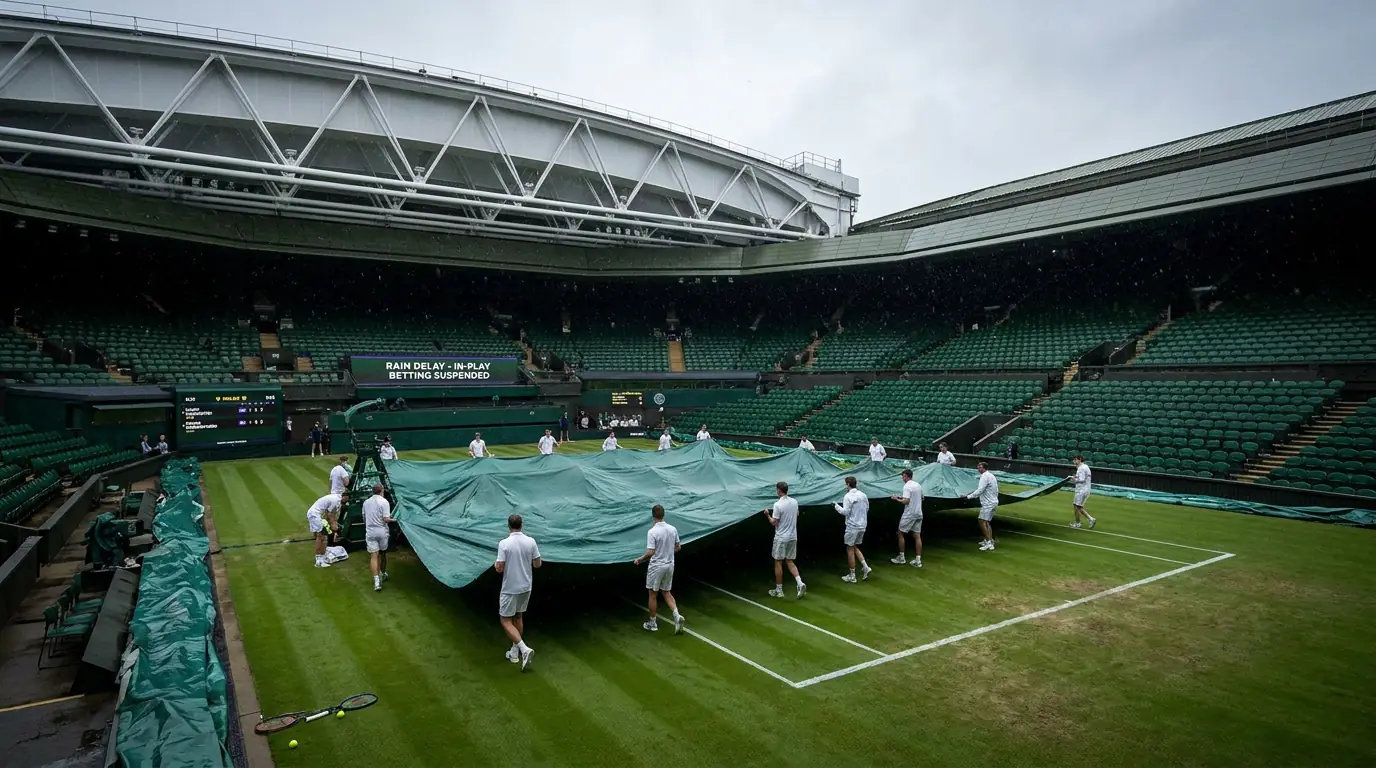
When play is suspended for rain at Wimbledon, in-play markets are typically suspended simultaneously. The moment the covers come on, bookmakers freeze the live betting lines and take no new bets until play resumes. This protects operators against bettors with superior weather intelligence — if a rain delay is coming and you can see it before the operator does, you cannot use that to your advantage because the market closes before the delay begins.
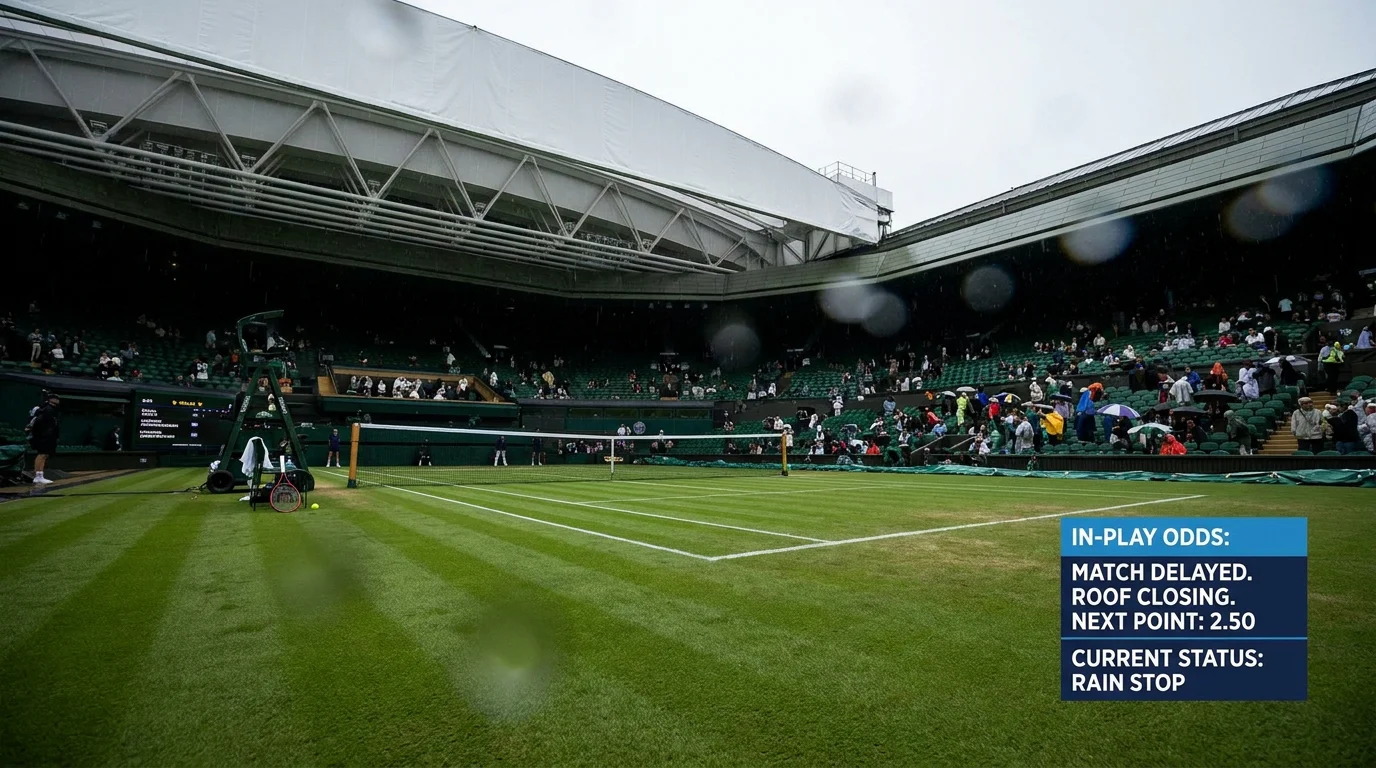
What does happen, and where the betting opportunity lies, is in the period immediately after play resumes. A rain delay of 30 minutes to two hours changes several match variables: the surface becomes slightly slower and higher-bouncing as moisture penetrates the grass; players who were in aggressive rhythm may find it disrupted; and the physical and psychological momentum of a match can shift in ways that the pre-delay in-play prices do not adequately capture.
The specific patterns I have observed: players who are winning through dominant serve performance tend to reassert that dominance quickly after a rain delay, because their advantage — serve speed and precision — is less affected by surface moisture than the return-of-serve game. By contrast, players who were building momentum through precise return games and long rallies often find the resumed surface more difficult because moisture slows the ball slightly, reduces the predictability of the bounce, and disrupts the rhythm they had established.
In-play prices at the moment of resumption — particularly on the first game after the restart — often do not fully account for this momentum disruption. A player who was serving at 3-4 and had just lost a service game before the rain came out may face a first serve game after the delay at a market price that treats the delay as neutral. The experienced in-play bettor knows it is not neutral, and prices accordingly.
The Centre Court Roof Effect on Grass-Court Betting Dynamics
Centre Court at Wimbledon has had a retractable roof since 2009, and Court 1 received its own roof in 2019. When the roof closes, the playing conditions change in predictable and significant ways that affect betting dynamics.
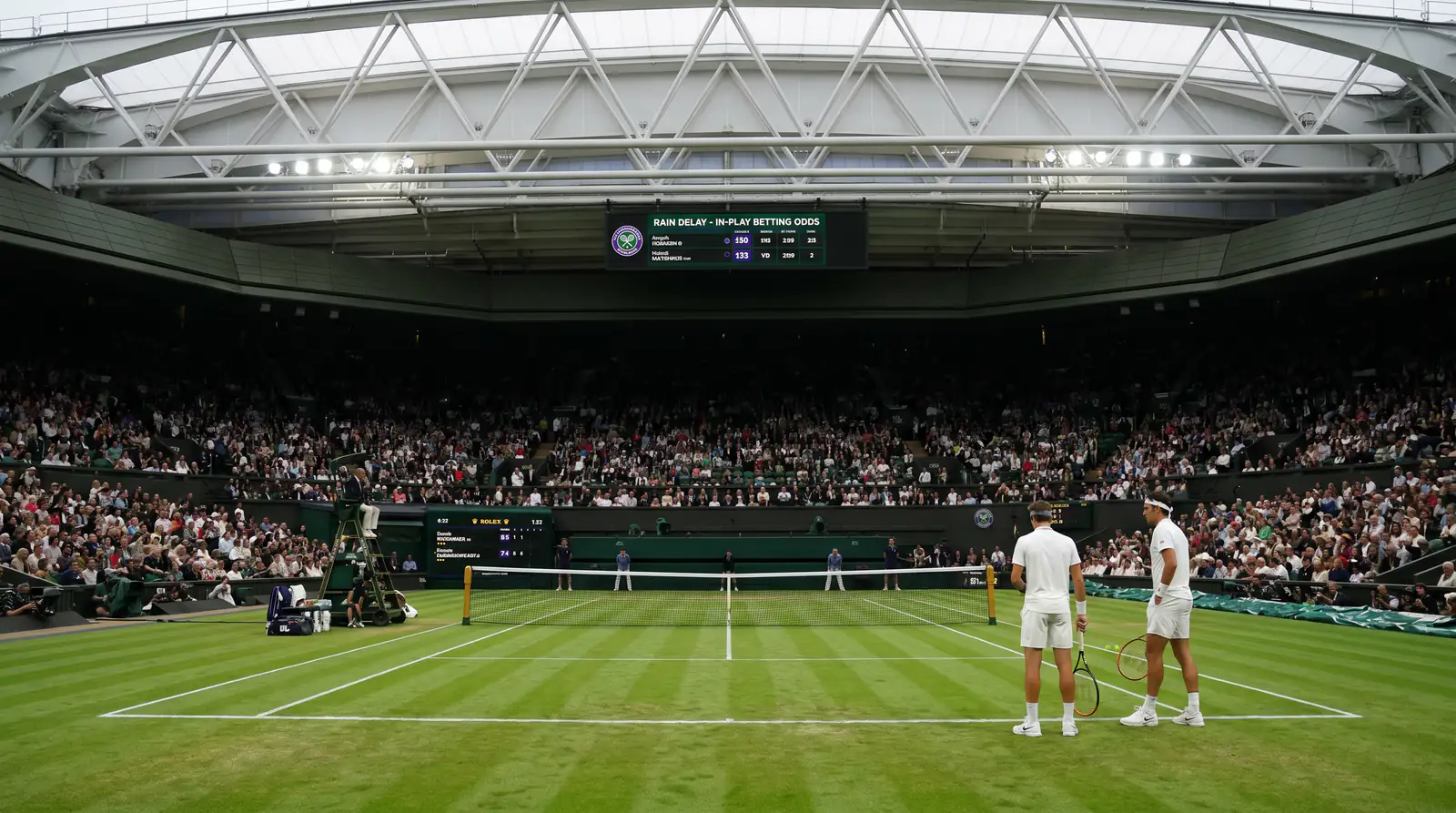
The most important effect is on surface speed. Under the roof, ambient humidity is controlled and wind is eliminated. The grass plays faster under the roof than in open conditions, because the reduced humidity keeps the surface firmer and the absence of wind removes a significant source of serve-and-volley disruption. Players who rely on aggressive net approaches — serve-and-volley, chip-and-charge tactics — tend to perform better under the roof because their approach shots are not diverted by unexpected crosswinds.
The second effect is on atmospheric pressure. Under the roof, the ball travels slightly differently — more predictably, with less air resistance variation. Players with extremely heavy topspin games — weapons developed on clay and hard courts — sometimes find their topspin loads less effective under controlled indoor conditions than in outdoor summer air. Conversely, flat, fast ball-strikers tend to benefit from the consistency.
From a set betting perspective: the roof tends to reduce the frequency of unexpected upsets in matches already underway. The equalising effect of outdoor conditions — unexpected bounces, wind disruptions, surface irregularities after repeated rain — is reduced under controlled conditions. Consequently, the pre-match favourite is modestly more likely to win in straight sets once the roof is closed than in open conditions.
Whether the roof closes is not always predictable with precision, but the BBC weather forecast for SW19 is reliable within a few hours, and the tournament’s operations team typically announces roof closures 30-60 minutes before implementation. Tracking this timing allows pre-match bettors to consider whether their selections are particularly advantaged or disadvantaged by roof conditions.
Wind and Surface Speed: The Underestimated Betting Variable
In-play betting accounts for 62.35% of total online sports betting volume, and during Wimbledon fortnight, wind conditions are an underused in-play input. SW19 in July can experience significant wind variation day to day and even hour to hour, particularly on the outer courts that are more exposed to the open air.
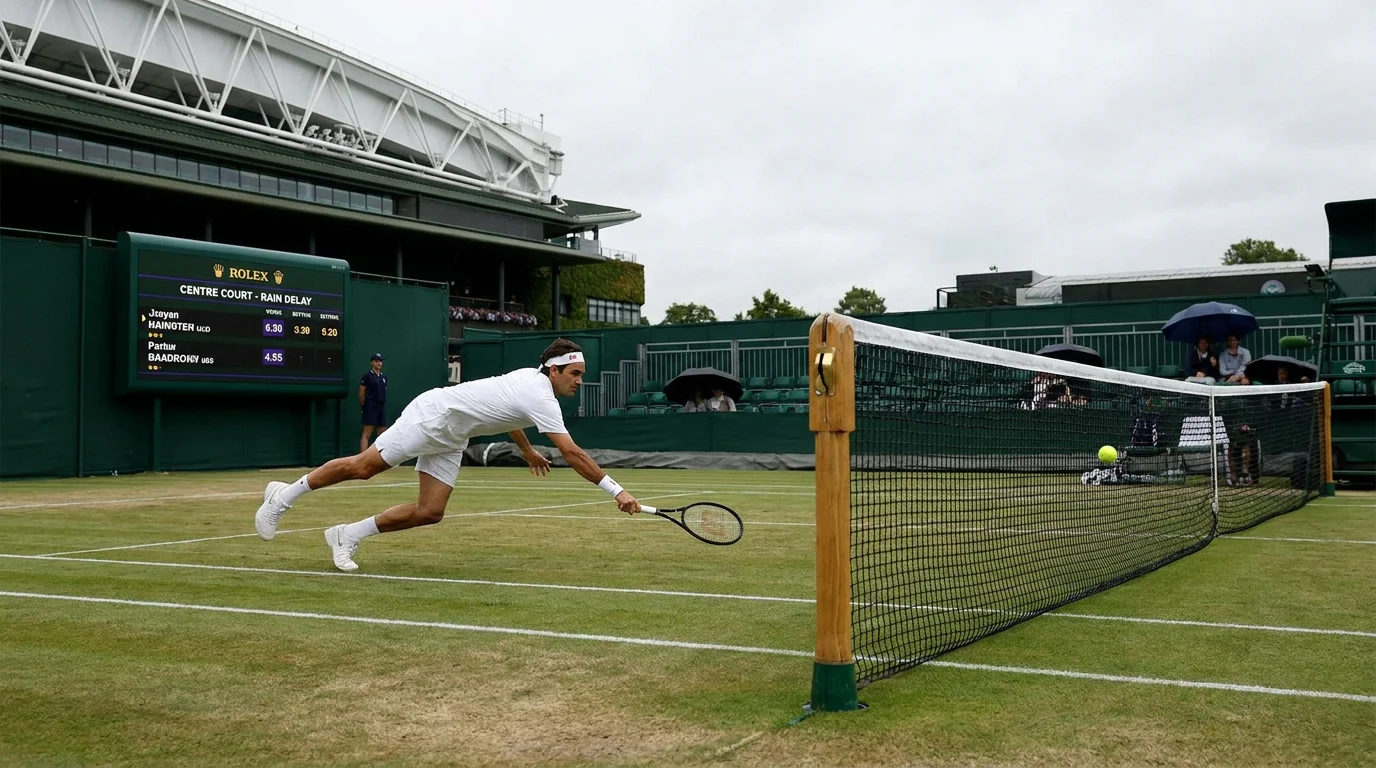
Wind affects tennis in three specific ways relevant to betting. First, it disrupts the ball toss on the serve, increasing double-fault rates among players whose serve mechanics are sensitive to toss variation. Second, it reduces the effectiveness of high-bouncing topspin as a rally weapon — wind catches the ball at the apex of the bounce and alters its trajectory, making the high-topspin game less predictable for the server but also less exploitable for the returner. Third, it extends rally lengths unpredictably, which shifts match dynamics toward fitness and physical resilience rather than serving precision.
The practical implication for in-play betting: on a windy day at Wimbledon, service game hold rates drop, rallies extend, and the effective playing conditions move marginally toward clay rather than the pure grass dynamic. A player whose strength is serve dominance on fast grass is marginally less dominant in wind; a player whose game is built on physical endurance and consistent rally play is marginally more competitive. When wind conditions on the day are noticeably stronger than the forecast implied at the time pre-match odds were set, there can be in-play value in outcomes that reflect this condition change.
Pre-Match Weather Check for Wimbledon Bettors
The five-point weather check I run before every significant Wimbledon bet is: forecast maximum wind speed at SW19 for the scheduled match time; likelihood of rain during the match window; whether the match is on a roofed court or an outer court; time of day (early starts often play in cooler, firmer surface conditions than afternoon matches as the day warms); and the previous day’s conditions (whether the surface has had time to dry from any prior rainfall).
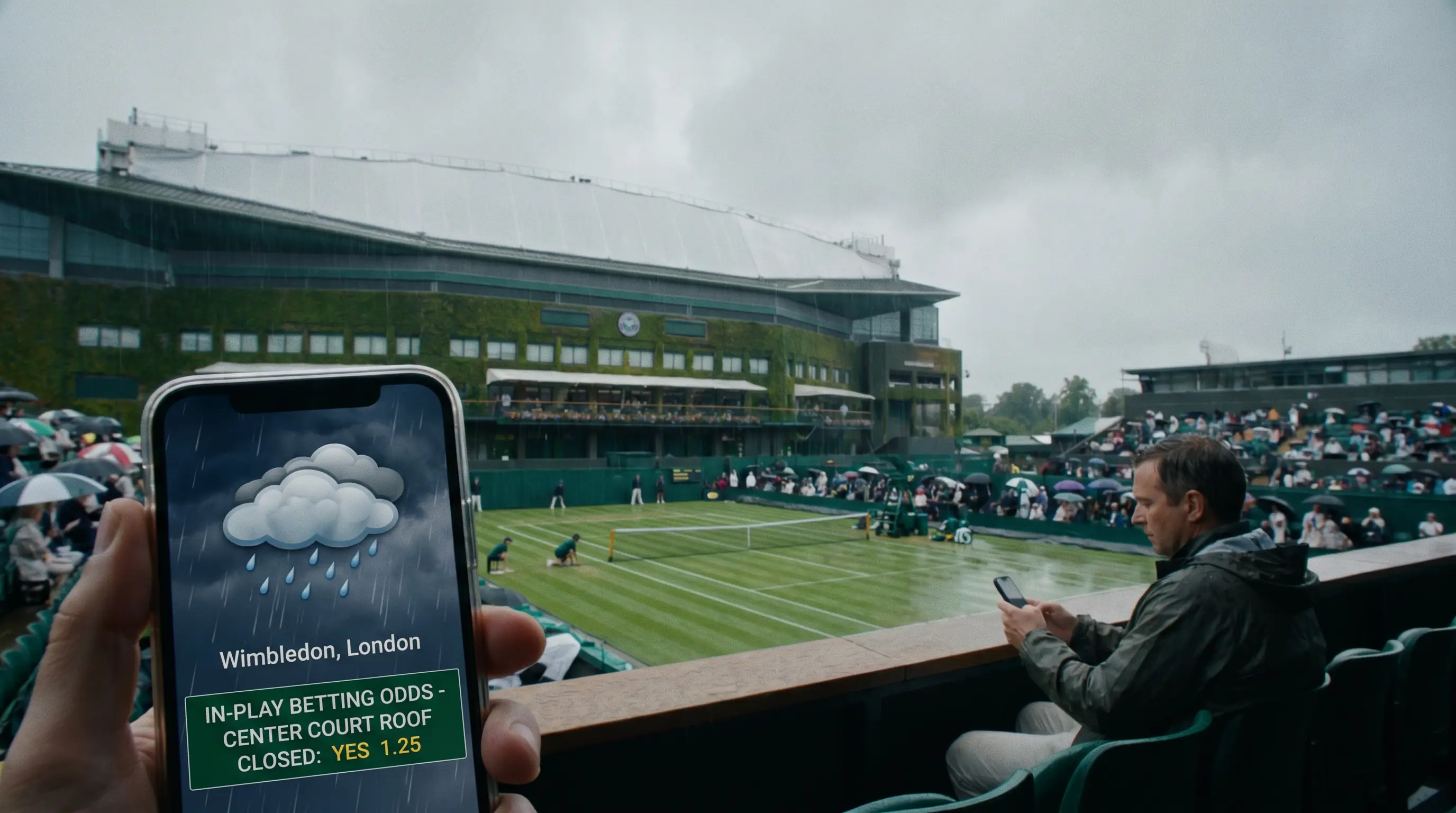
None of these individually determines the value of a Wimbledon bet. But in combination, they tell me whether the effective playing conditions I am betting on match the conditions priced into the pre-match lines. When they diverge — when windy or wet conditions are forecast but pre-match prices were set in calm conditions — there is a basis for reconsidering the value of specific selections.
For the full framework of in-play betting at Wimbledon and how to react to live match dynamics — of which weather is one component — the detailed guide is at Wimbledon in-play betting.
Frequently Asked Questions
Articles



Written by the editors at bettingonwimbledontennis.
