
Queen's Club and Wimbledon Betting: How Much Does the Warm-Up Really Matter?
 Available in US
Player form is the primary factor for 37% of UK Wimbledon bettors when deciding their selections — and for most of them, “form” means the Queen’s Club results. The Cinch Championships at Queen’s Club is the single most visible pre-Wimbledon form indicator available, and operators react to its results faster and more aggressively than to any other warm-up event. A player winning Queen’s can see their Wimbledon price cut by 30-40% within 48 hours of lifting the trophy. The question I have been asking for nine years is: does the market react correctly, or does it overreact? The data is quite clear — and it should change how you use Queen’s in your Wimbledon betting analysis.
Queen’s Club Win Rate to Wimbledon Title: What the Data Shows
Between 2010 and 2024, the Queen’s Club men’s singles champion went on to win Wimbledon three times out of 14 editions — a 21% hit rate. In those same 14 years, the Queen’s runner-up won Wimbledon twice. That means the two players who contested the Queen’s final combined won Wimbledon five times out of 14 — a 36% collective hit rate from the two finalists. In isolation, these numbers look moderately predictive. The problem is that the two finalists at Queen’s are almost always among the top-eight seeds at Wimbledon anyway — players who would have been 25-35% collective probability at Wimbledon regardless of their Queen’s result.

The specific question is: does winning or reaching the Queen’s final add predictive information above and beyond what the player’s grass-court record and Wimbledon seeding already tell you? When you control for baseline grass-court quality — which can be assessed from ATP grass win percentages over 18 months — the Queen’s result adds only marginal predictive value for the Wimbledon winner. A player who goes deep at Queen’s is not significantly more likely to win Wimbledon than a player with the same grass record who skipped Queen’s to prepare quietly.
This has a direct betting implication. When a Queen’s champion sees their Wimbledon price cut from 7/1 to 4/1 purely on the strength of one week’s results, the market is overreacting. The price compression is real and happening, but it is pricing in more information than the Queen’s result actually contains. A player at 4/1 after winning Queen’s who was previously at 7/1 needs to be assessed on their full grass record and physical condition — not on the Queen’s trophy alone.

Halle Open vs. Queen’s Club: Which Better Predicts Wimbledon Form
The Halle Open — the Noventi Open, held in Germany on grass during the same week as Queen’s Club — is a significantly underweighted predictor in most UK Wimbledon betting analysis. The reason it receives less attention is simple: Queen’s Club is in London, receives extensive BBC and British press coverage, and involves UK-based and high-profile players who generate more domestic interest. Halle is covered but not with the same intensity.
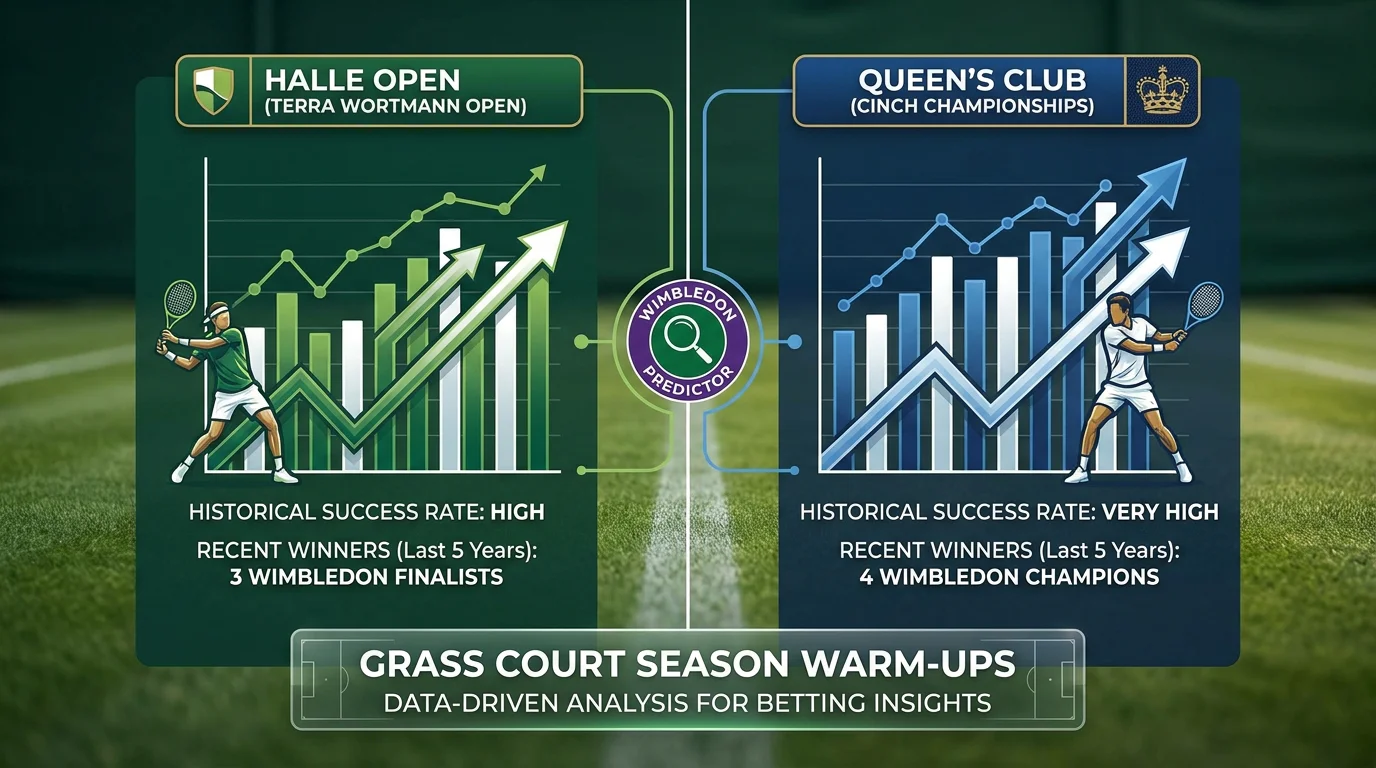
But there is a genuine case that Halle is a better Wimbledon predictor than Queen’s for the men’s draw. The Halle surface plays faster than Queen’s in recent years — the grass preparation at the Gerry Weber Open Stadion produces a consistently quick, low-bouncing surface that closely mirrors the conditions on the Centre Court at Wimbledon. Players who perform well at Halle under these faster conditions are demonstrating the specific serve-and-return balance that Wimbledon’s Centre Court demands.
Historically, Halle winners have won Wimbledon at approximately the same rate as Queen’s winners. But Halle finalists who do not win the title are sometimes more interesting Wimbledon ante-post candidates than their Wimbledon market prices reflect, precisely because the final result at Halle receives less market attention than the Queen’s result. A player who reached the Halle final in two sets from a strong draw, but lost the final, may represent better Wimbledon value than a Queen’s champion whose path to the title involved three close matches in damp conditions.
When Warm-Up Results Mislead Wimbledon Bettors
The Wimbledon 2026 prize fund stands at £53.55 million, a 7% increase that ensures the tournament attracts the full field of elite players regardless of their warm-up schedule. But the grass swing leading up to Wimbledon is not risk-free for players, and the results it produces are not always representative of actual Wimbledon readiness.
Three specific scenarios where warm-up results mislead: first, the player who wins Queen’s after a lighter-than-expected draw. A champion who faced an unseeded player in the semi-final and a qualifier in the final has not tested themselves against the depth of the Wimbledon main draw. The trophy is real, but the competitive examination was limited. Second, the player who loses in the first round of Queen’s but was managing a minor injury and withdrew early to prioritise Wimbledon preparation. A first-round Queen’s exit says nothing about this player’s Wimbledon readiness — but the market may lengthen their price as if it does. Third, players who skip the warm-up events entirely. Some elite players — particularly those with deep Queen’s body of work on grass — skip one or both warm-up events to rest and prepare specifically for Wimbledon. Their absence from the warm-up circuit creates pricing uncertainty that the market typically resolves by extending their price, creating an opportunity for bettors who trust the underlying grass record.
The fourth misleading scenario is the player who arrives at Queen’s after a clay-court semi-final the previous weekend. A player who contested a demanding clay-court match three or four days before Queen’s begins has less preparation time for the surface transition than one who finished their clay schedule two weeks earlier. Early exits at Queen’s in this context can reflect physical management — protecting the body for Wimbledon — rather than genuine grass-court deficiency. These players are often underpriced for Wimbledon after an apparently poor Queen’s result, and represent some of the better ante-post opportunities of the grass swing.
The framework that works: use warm-up results as confirmation or contradiction of a player’s grass-court readiness, not as primary evidence. A player with an outstanding 18-month grass record who loses early at Queen’s in a competitive match against a tough opponent is not a diminished Wimbledon prospect. A player with a weak grass record who wins Queen’s against a soft draw has not transformed into a Wimbledon favourite. The warm-up provides data; it does not override the structural analysis.
For the full context of how player form integrates with grass-court statistics and draw position in a complete Wimbledon assessment framework, the strategic overview is at grass court tennis betting strategy.
Frequently Asked Questions
Articles



Written by the editors at bettingonwimbledontennis.
