
Seven Wimbledon Betting Mistakes UK Punters Make — And the Data Behind Each One
 Available in US
The most honest thing I can tell you about Wimbledon betting mistakes is that I made most of them before I understood the data well enough to stop. These are not exotic errors — they are the standard collection of cognitive biases and analytical shortcuts that cost UK punters money year after year at SW19. The evidence base for calling them “mistakes” is specific: player form is the number one input of experienced Wimbledon bettors (37%), and the bettors who consistently lose at Wimbledon are disproportionately those who use a different hierarchy — either intuition first, or narrative first, or surface-agnostic rankings first. What follows is a precise account of seven of those errors, each anchored in data rather than general observation.
Seven Data-Backed Wimbledon Betting Mistakes
Mistake one: treating ATP/WTA rankings as grass-court rankings. ATP and WTA rankings aggregate performance across all surfaces — hard, clay, and grass — on a rolling 12-month basis. A player ranked fifth in the world has earned those points predominantly on hard courts (the surface used for the most events on both tours) and clay (Roland Garros points). Their grass-court record may be thinner than that ranking implies. The direct consequence in the market: players ranked 1 through 8 are often priced at Wimbledon as if their ranking directly reflects grass ability, when the most accurate predictor — grass-specific win rate over the previous two seasons — sometimes tells a different story entirely.

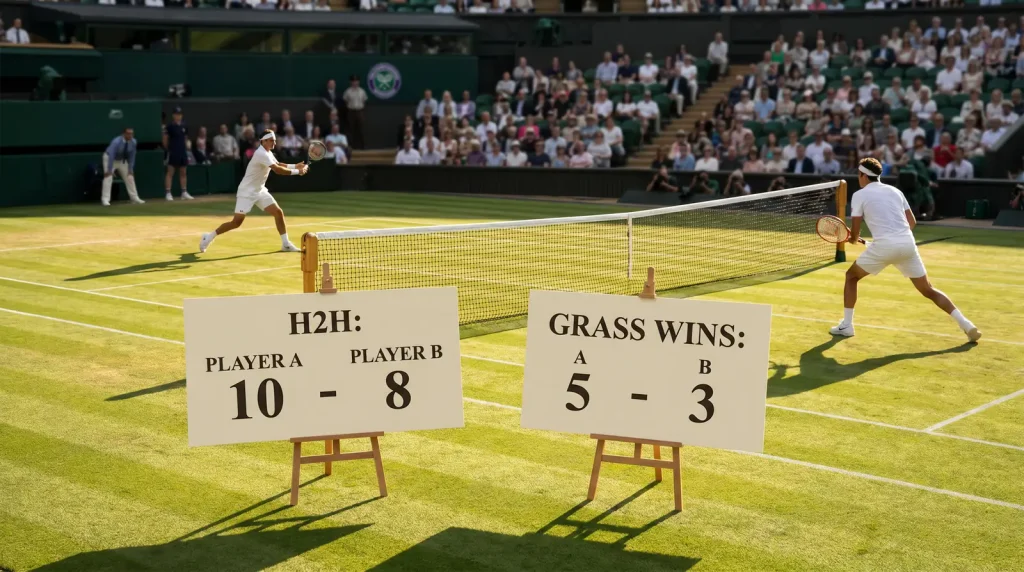
Mistake two: overweighting head-to-head records across all surfaces. H2H is the fourth-most cited factor in decision-making at 10%, and even that modest weight is often misapplied. A 12-5 H2H advantage from an all-surface record can disappear entirely when you filter for grass-only meetings and find a 2-2 or 3-3 split. Worse, a small grass-court sample is not statistically meaningful — three meetings on grass is not a pattern, it is an anecdote. The correct approach is to use grass-specific H2H where the sample is large enough (six or more meetings) and to weight all-surface H2H very lightly when the grass sample is small. Most casual bettors apply the aggregate record without this filter.
Mistake three: using French Open form as Wimbledon preparation. Tennis operates on three surfaces that reward fundamentally different technical skills. The topspin-heavy baseline game that dominates Roland Garros is actively penalised on Wimbledon’s fast grass, where high-bouncing topspin shots sit up for aggressive returns and short rallies neutralise baseline consistency. A player who reaches the Roland Garros final, takes two weeks off, and then arrives at Queen’s Club is in a very different technical position from one who has been playing grass events continuously. Assuming Roland Garros momentum carries into Wimbledon is one of the most consistently expensive errors in the market.
Mistake four: ignoring the 22% of seasonal bettors. This one works the other way round — it is a market structure mistake rather than an analytical one. Only 7% of UK bettors follow tennis throughout the year; 22% bet exclusively at Grand Slams. The Wimbledon market therefore contains a higher proportion of once-a-year participants than almost any other major sporting event. Once-a-year bettors are price-insensitive on the obvious selections — they back the top seeds without shopping for the best odds, and they weight narrative (British hope, defending champion, former champion returning) over analytical assessment. Understanding that this segment creates specific pricing inefficiencies — particularly overpriced top seeds in outright markets, particularly when a British player is in the draw — is not exploiting the naive; it is correctly reading what the market is made of.
Mistake five: placing all bets before the draw is made. Ante-post outright betting at Wimbledon before the draw is a fundamentally different exercise from post-draw match betting. The draw creates enormous variance in individual match difficulty, and the same player in an easy quarter of the draw versus a difficult one is not the same bet at the same price. Placing all Wimbledon bets ante-post, before knowing the draw structure, means accepting a price that does not account for the path. For outright bets, this is sometimes justified by the better odds available pre-draw. For match bets and early-round selections, it is almost always an avoidable inefficiency — the draw is public knowledge before bets need to be placed.
Mistake six: treating Wimbledon as an isolated event rather than part of a performance arc. Wimbledon sits between the clay swing ending at Roland Garros and the hard-court swing beginning with the North American masters. Some players peak in the grass window; others carry clay-court fitness into the grass events but are not technically optimised for the surface. A player in the middle of a multi-surface transition — strong clay results, moderate grass warm-up results, clearly building toward the US Open hard-court series — is in a very different betting position from one who specifically prepares for the grass window and peaks at Wimbledon annually. This performance arc context is absent from most pre-tournament analysis but consistently separates reliable Wimbledon selections from unreliable ones.
Mistake seven: not accounting for withdrawal risk in ante-post markets. Wimbledon occupies 11% of UK planned betting events, which sounds modest, but for the punters who do bet, it often represents their largest single wager of the tennis year — or the year entirely. Placing that wager ante-post without confirming the operator’s withdrawal rules is a fundamental risk management failure. The standard terms divide into: non-runner, no-bet (stake returned if player withdraws) or ante-post rules apply (bet loses if player does not compete). The difference between these two terms on a significant ante-post bet — with a top-five player who plays a demanding clay schedule — can be the difference between a returned stake and a total loss.
The Correction for Each Mistake: Practical Steps
Seven mistakes, seven corrections — stated briefly.


For ranking confusion: build a personal grass-specific win rate table for the top 32 players entering the draw, using the last two full Wimbledon seasons. This is a 90-minute exercise before the draw and it is the single most useful pre-tournament analytical task available to a non-institutional bettor.
For H2H misuse: filter every H2H to grass-only meetings before assigning any weight. Fewer than four grass meetings: ignore the H2H entirely. Four to six: minor weighting. Seven or more: meaningful input.
For clay-form carryover: add a surface-switch penalty to any player who is coming directly from a deep run at Roland Garros into Wimbledon with limited grass-court preparation. The specific magnitude of the penalty is judgement-based, but acknowledging that it exists will prevent the worst overpricing of recent clay form.
For seasonal-bettor exploitation: identify the players who carry narrative weight in the domestic market — British players, former champions, returning names with previous high profiles — and verify that their current grass form justifies their market price before following public money.
For pre-draw positioning: limit ante-post outright bets to the players where the draw position is genuinely unlikely to change the fundamental value case significantly. For match-specific betting, wait for the draw and assess the first-round opponent before committing.
For performance arc misreading: look at each player’s previous two Wimbledon draws holistically — not just their round reached, but their match quality, service stats, and physical condition relative to the current year. The Wimbledon context of a player who had an early exit due to injury looks very different from one who lost to a better-prepared grass specialist.
For withdrawal risk: check the operator’s ante-post terms before placing any significant pre-tournament bet. Non-runner, no-bet is preferable where available. If ante-post rules apply, factor the withdrawal probability into your expected value calculation — it is not zero, particularly for elite players with demanding pre-Wimbledon schedules. The full framework for grass-court preparation and strategic betting is at grass-court tennis betting strategy.

Articles


Written by the editors at bettingonwimbledontennis.
