
Fractional and Decimal Odds at Wimbledon: A UK Punter's Practical Reference
 Available in US
A few years ago I was sitting next to a sharp punter at a sports betting seminar who told me he had been betting on tennis for six years before he fully understood what a price actually meant. Not the mechanics — he knew that 5/2 meant winning £5 for every £2 staked — but what it meant in terms of probability, and therefore in terms of value. That gap between knowing the format and understanding what it represents is where most recreational bettors lose money without realising it. The UK online sports betting market generated £7.371 billion in revenue in 2024, with online bets making up 78.47% of all staking by volume. A significant fraction of that revenue comes from punters who are effectively wagering against prices they do not fully understand. This guide is the fix for that.
Fractional Odds: The UK Standard Explained With Wimbledon Examples
Fractional odds express profit relative to stake. If you see a Wimbledon favourite priced at 4/6, the fraction tells you that for every £6 you risk, you profit £4 if the bet wins. Your total return — stake back plus profit — is £10. If you see an outsider at 14/1, you profit £14 for every £1 staked, returning £15 in total.
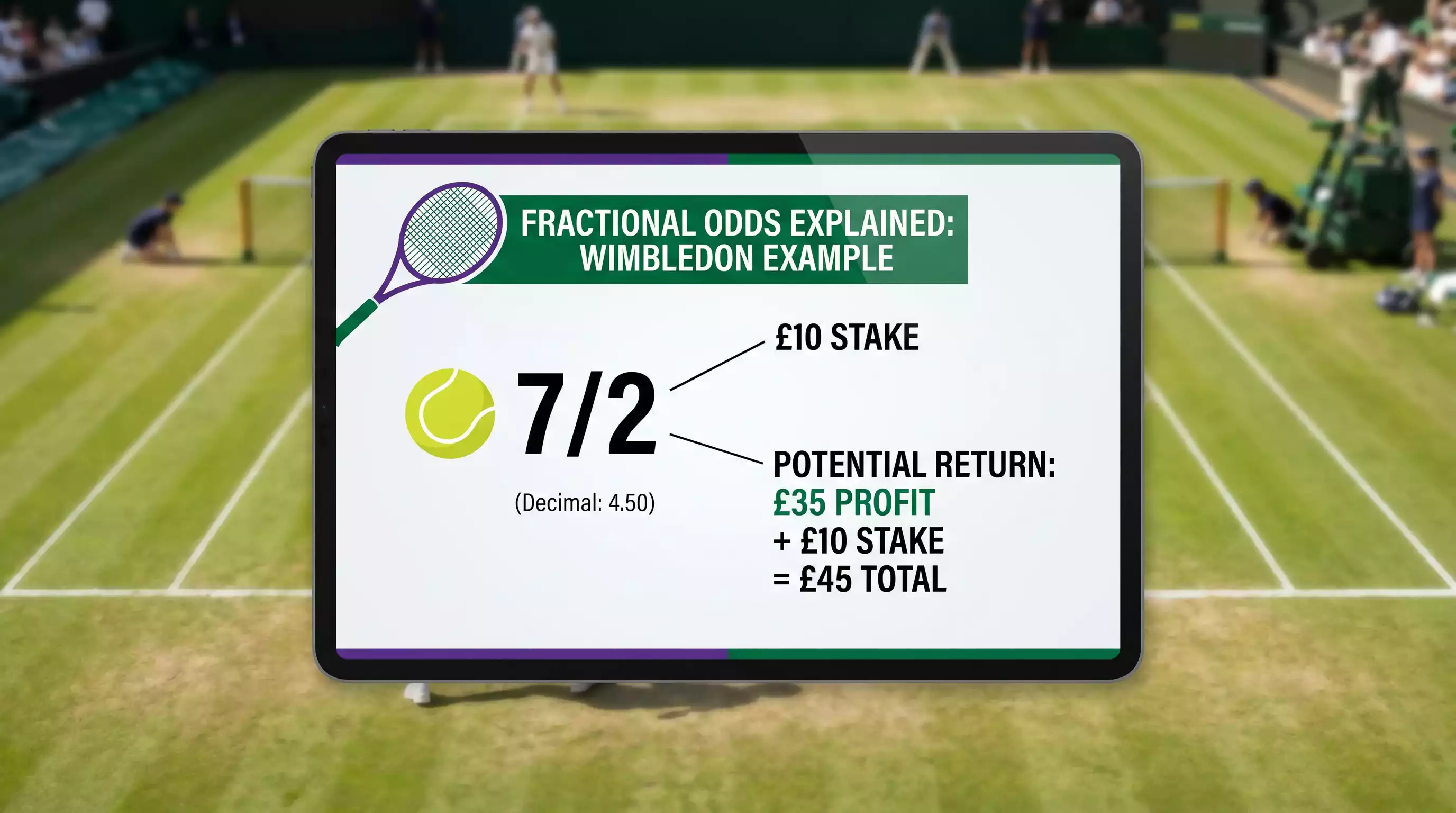
The arithmetic is straightforward, but the more important skill is reading what the fraction implies about probability. The formula is: implied probability = denominator / (denominator + numerator). For 4/6: 6 / (6 + 4) = 60%. The market is saying this player has a 60% chance of winning. For 14/1: 1 / (1 + 14) = 6.7%. The market assigns roughly a 1-in-15 chance.
Some fractions trip people up because they are not in lowest terms. 6/4 is the same as 3/2 — you profit £6 for every £4 staked, or equivalently £3 for every £2. Many operators display 6/4 rather than 3/2 purely by convention; the value is identical. Similarly, 10/11 and 20/22 are the same price. When comparing odds across bookmakers, always convert to implied probability or decimal to ensure you are making a like-for-like comparison.
The key fractions to know by heart for Wimbledon betting: Evens (1/1) means 50% implied probability. Odds-on means better than evens — the denominator is larger than the numerator, so 4/6 is odds-on. Odds-against means worse than evens — the numerator is larger than the denominator, so 6/4 is odds-against. “Odds-on favourite” is a shorthand for a player whose implied probability is above 50%.
Decimal Odds: Why Some UK Platforms Have Switched
Decimal odds have been gaining ground at UK bookmakers for the past decade, and are now the default on several major platforms. The format expresses total return per unit staked, including your original stake. A Wimbledon player at 1.80 decimal returns £1.80 total for every £1 staked — meaning £0.80 profit. A player at 5.00 returns £5 total, meaning £4 profit.

The conversion from fractional to decimal is simple: decimal = (numerator / denominator) + 1. So 4/1 becomes 5.00, Evens becomes 2.00, and 4/6 becomes (4/6) + 1 = 1.67. The reason platforms prefer decimal is precisely that arithmetic — it is easier to compare prices and calculate multi-leg accumulators when you are multiplying decimals rather than fractions. A three-leg Wimbledon accumulator at 5/2, 11/10 and 6/4 requires more arithmetic than simply multiplying 3.50 × 2.10 × 2.50 to get a total return of 18.375 for a £1 stake.
The practical advice: use whichever format your operator displays by default, but understand that all UK operators allow you to toggle between fractional and decimal in the account settings. If you find yourself struggling with a particular price, switching to decimal temporarily for comparison purposes is entirely reasonable.
Converting Odds to Probability: The Formula UK Bettors Need
Understanding implied probability is the single most important mathematical skill in sports betting, and it is not complicated. The core formula for fractional odds: probability = denominator / (denominator + numerator). For decimal odds: probability = 1 / decimal odds.
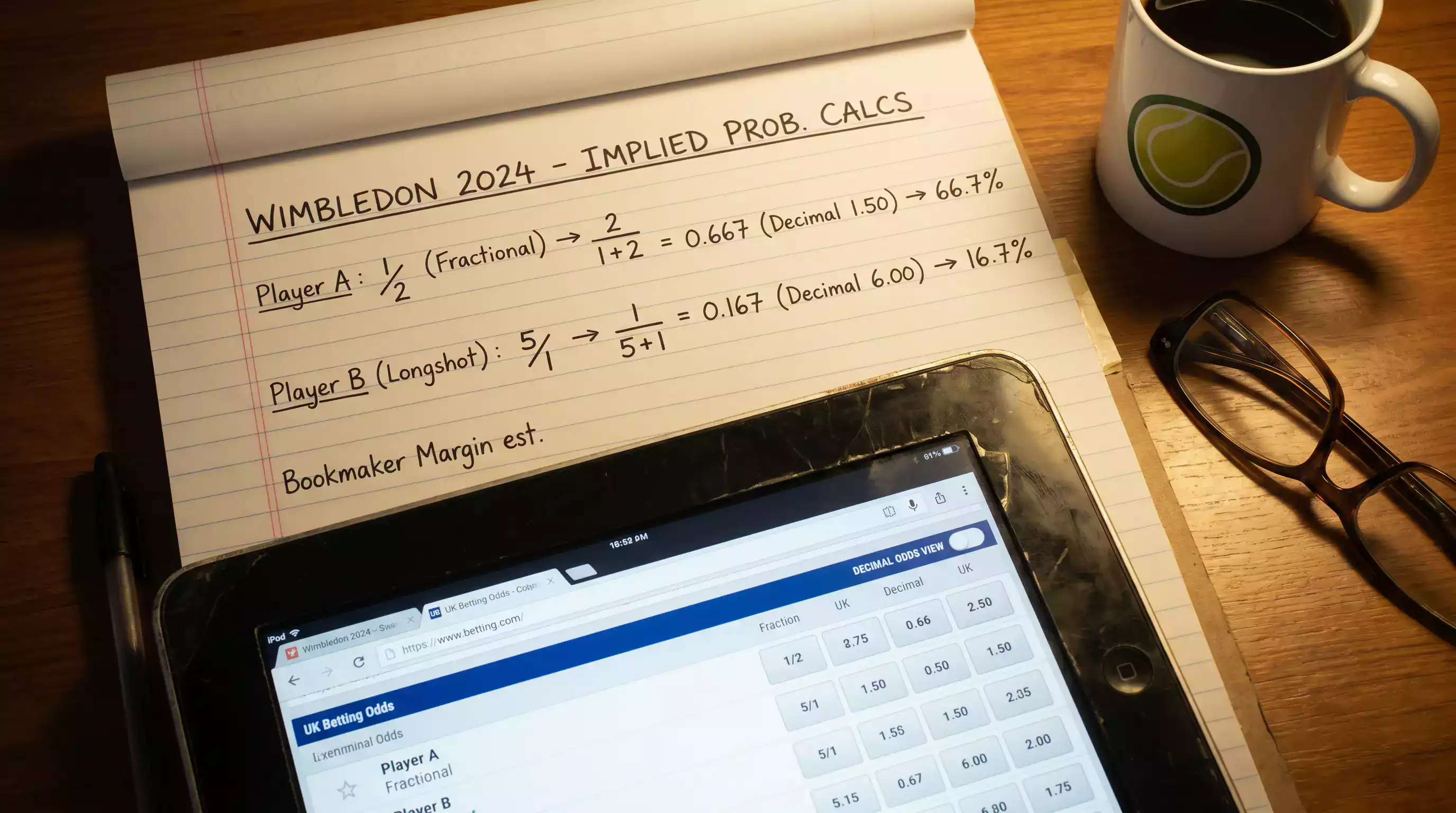
Working examples with Wimbledon prices: a player at 7/2 fractional has an implied probability of 2 / (2 + 7) = 22.2%. The same player in decimal at 4.50 gives 1 / 4.50 = 22.2%. A player at 2/5 has an implied probability of 5 / (5 + 2) = 71.4%. The decimal equivalent is 1.40, so 1 / 1.40 = 71.4%. The numbers always match — they are the same price expressed differently.
The practical use of this formula is that it allows you to ask the fundamental question of value betting: does the bookmaker’s implied probability match your own assessment of the player’s chances? If you think a player has a genuine 30% chance of winning a Wimbledon quarter-final, you need odds of at least 10/3 (3.33 decimal) to be at fair value. If the market is offering 5/2 (3.50 decimal), you have a value bet — the market is implying 28.6% probability, slightly lower than your assessment. If the market is offering 9/4 (3.25 decimal), the market implies 30.8%, marginally above your assessment, and the bet has negative expected value.
The Bookmaker’s Edge: How Much Does Wimbledon Overround Cost You?
The UK sports betting market is projected to reach $21.3 billion by 2030 at an 11.4% CAGR. The bookmaker’s share of that growth is secured by the overround — the structural built-in margin that ensures operators profit over the long run regardless of results. Understanding how overround works on Wimbledon markets helps you choose which markets to target and which to avoid.


The overround on a two-player Wimbledon match-betting market is the sum of both players’ implied probabilities. If Player A is priced at 4/7 (implied probability 63.6%) and Player B is priced at 11/8 (implied probability 42.1%), the sum is 63.6% + 42.1% = 105.7%. The 5.7% above 100% is the operator’s margin. To break even against this overround, your win rate on these bets needs to exceed the fair probability by 5.7 percentage points on average.
Overround varies by market type. Match betting on high-profile Wimbledon matches — Centre Court, prime-time scheduling — typically carries lower overround (3-5%) than niche markets like correct set score or prop bets, which can carry 8-15% margins. The highest margins on Wimbledon markets are typically found in speculative single-game markets, in-play exotic markets during lower-profile matches, and any market where the bookmaker has limited data to price efficiently.
The implication for value-seeking punters: target the markets with the tightest overround (standard match betting on marquee matches), and be extremely selective about high-margin markets. The correct set score market is seductive because the prices look large, but if the overround is 12%, you need to be significantly better at assessing correct scores than a typical punter to show a profit. That is possible — but it requires specific preparation, not general Wimbledon knowledge.
For the full range of Wimbledon betting markets and how they compare in terms of value and overround, the comprehensive guide is at UKGC-licensed bookmakers for Wimbledon, which also covers how different operators structure their odds on the same markets.
Frequently Asked Questions
Articles




Written by the editors at bettingonwimbledontennis.
