
Wimbledon Betting vs. Other Grand Slams: Why SW19 Is in a Category of Its Own
 Available in US
Wimbledon’s global sponsorship income reached $124.7 million across 17 commercial deals in 2024 — the highest of any Grand Slam. That figure is a useful opening position because it immediately illustrates something that UK bettors sometimes underestimate: Wimbledon is not just culturally different from the other three majors, it is commercially different in ways that directly affect betting market depth, operator competition, and the value available to punters who understand how to read those differences.
Surface Differences: How Odds Behave Across the Four Majors
The four Grand Slams are played on three surfaces: hard court (Australian Open and US Open), clay (Roland Garros), and grass (Wimbledon). Each surface produces a distinct statistical profile, and those profiles translate into genuinely different betting market characteristics — not just in terms of which players are favoured, but in terms of how odds are priced, how volatile early-round results are, and how reliably form converts to outcomes.
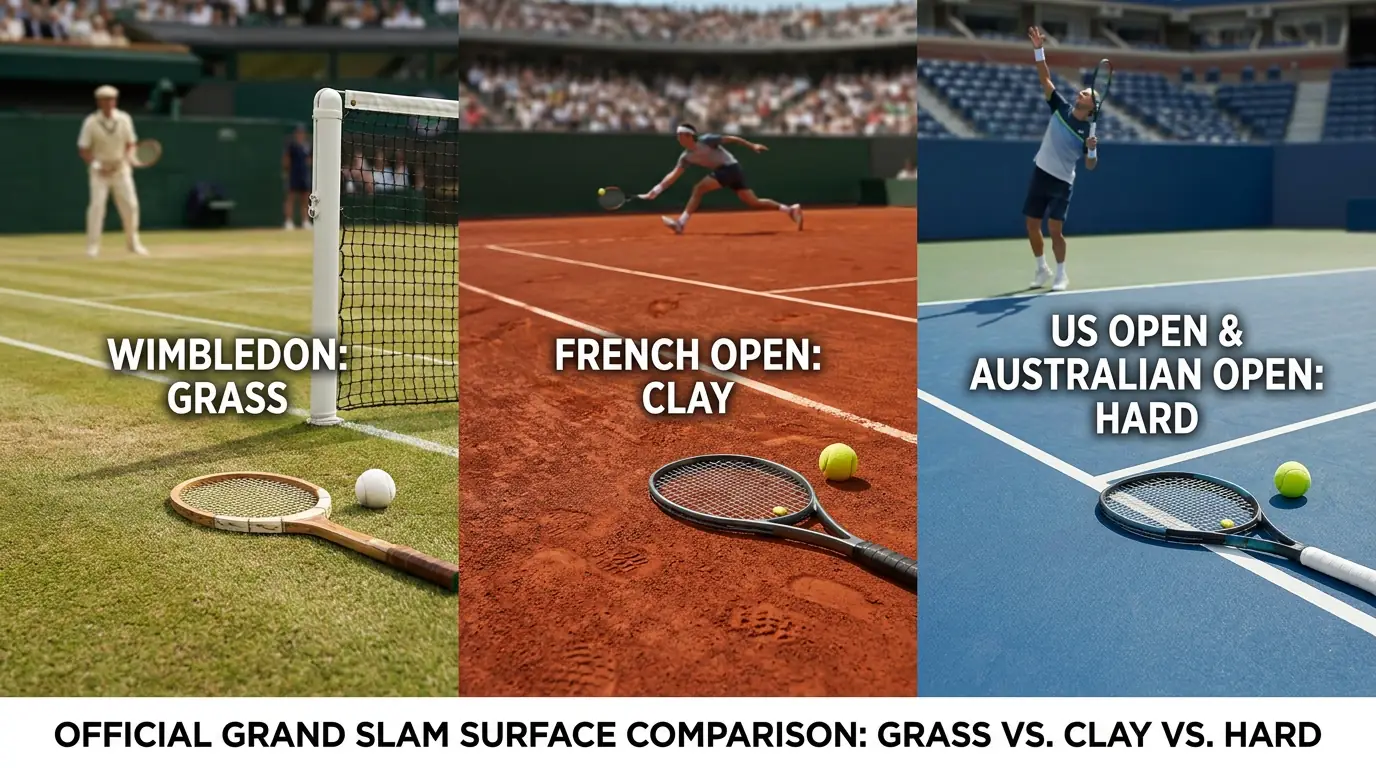
Clay at Roland Garros is the surface of stamina and baseline attrition. Matches are longer, upsets are less common in the early rounds among the elite, and the specialists who dominate clay — players with heavy topspin forehands and exceptional movement — are identifiable well in advance. This predictability is reflected in the market: the French Open typically produces the most accurately priced outright markets of the four majors, because the surface rewards a clearly defined skill set that is measurable across a full clay season. For bettors, this means value is harder to find in the French Open outright. The bookmakers are better calibrated to clay specialists than to any other player type.
Hard court at the Australian Open and US Open produces the most balanced surface in professional tennis. Hard court does not strongly favour any particular playing style — it suits serve-and-volley players, baseliners, and all-court players — which means player rankings and outright prices are the most correlated with actual outcomes. These two majors also produce the deepest markets by volume, because hard court tennis is the most globally televised and therefore has the largest betting audience. Tight pricing — low overround — is more consistently available at Australian Open and US Open than at the other two majors simply because the volume of money in those markets drives operator competition harder.
Grass at Wimbledon is where the betting picture diverges most sharply from standard ranking-based pricing. As the only grass-court Grand Slam, Wimbledon has no seasonal comparator. A player’s grass-court form is evaluated on a thin sample — primarily the pre-Wimbledon swing of one to three weeks — which creates more uncertainty in pricing than either clay or hard-court markets carry. As Unibet’s official guide noted, the grass “creates unique betting dynamics compared to other majors” precisely because fast serves, short rallies, and unpredictable bounces introduce a variance component that no amount of ranking data can fully neutralise.
Betting Market Depth: Wimbledon vs. Australian Open vs. US Open
Wimbledon’s total market value is estimated at $1.2 billion — a figure that reflects both its commercial infrastructure and its cultural authority. For the betting market, this translates into something practical: UK operators compete harder for Wimbledon betting business than for any other tennis event, and that competition produces wider market coverage, more promotional activity, and — in the fortnight of the tournament itself — tighter margins on the most popular markets than you will find at the Australian Open or US Open in the UK market.

The depth advantage is not uniform. In outright markets — winner of the men’s and women’s singles — Wimbledon, the Australian Open, and the US Open all attract comparable liquidity from the large UK betting audience. The difference is in the secondary markets: set betting, game handicaps, first-set betting, player-specific propositions (number of aces, tiebreak frequency). At Wimbledon, these markets are priced by specialist tennis traders at every major UK operator. At the Australian Open, the same depth exists. At Roland Garros, UK market depth in secondary markets is somewhat thinner because the clay-court audience skews slightly more European-continental in its betting profile.
The US Open presents an interesting case. It is played in late August on hard courts in New York, with the UK evening schedule often catching the early rounds at a social hour that suits casual betting. UK market volume at the US Open is strong, but the time difference (matches typically finishing at UK midnight or beyond) caps live betting engagement in a way that Wimbledon’s afternoon scheduling does not. This scheduling factor is partly why Wimbledon produces more in-play betting volume per match from the UK market than any other Grand Slam — the tournament plays at the optimal time for the UK betting audience.
Two-Week Format: Why Wimbledon’s Schedule Suits In-Play Bettors
Tennis is the fastest-growing sport in online betting, with a CAGR of 13.83% projected through to 2031. A significant portion of that growth is attributable to in-play betting, which now represents over 62% of online betting volume. Wimbledon’s specific scheduling model is one reason the tournament punches above its weight in generating in-play turnover.
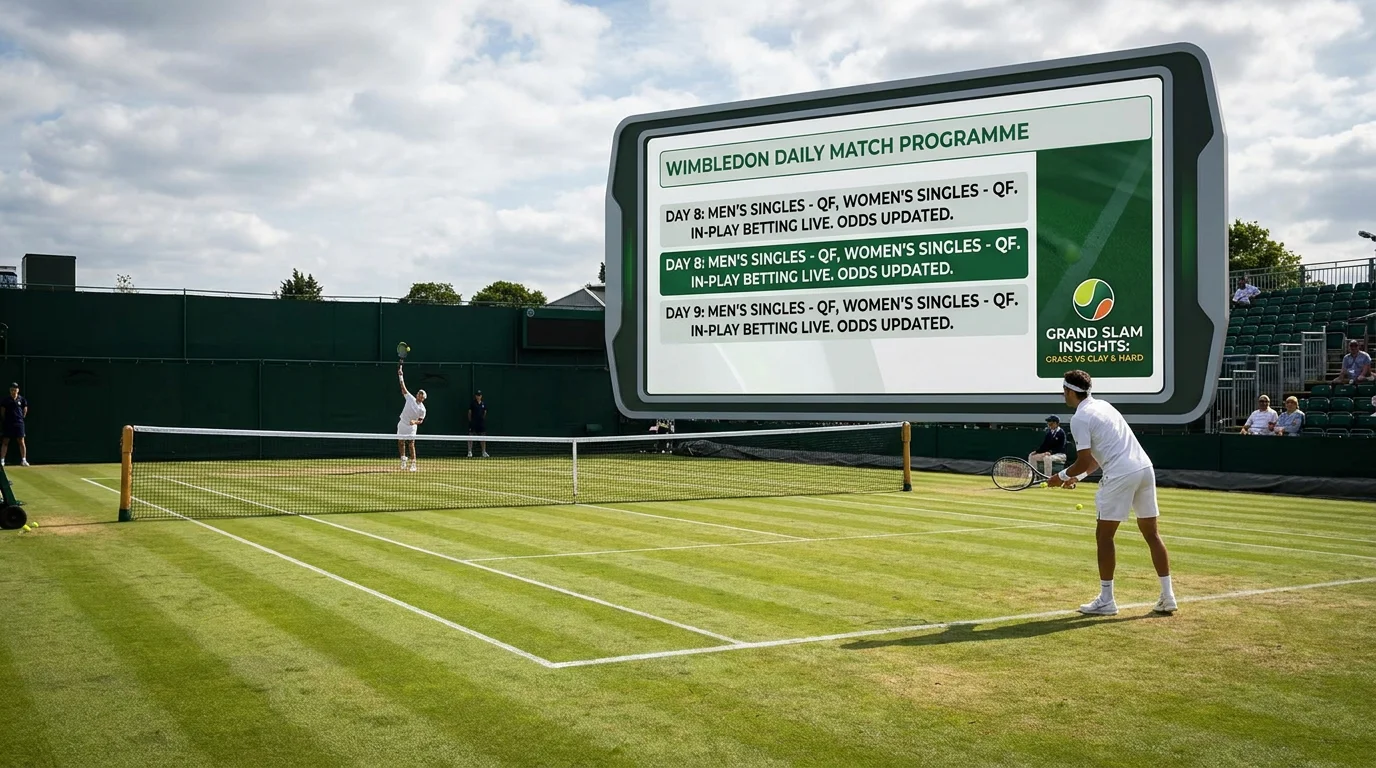
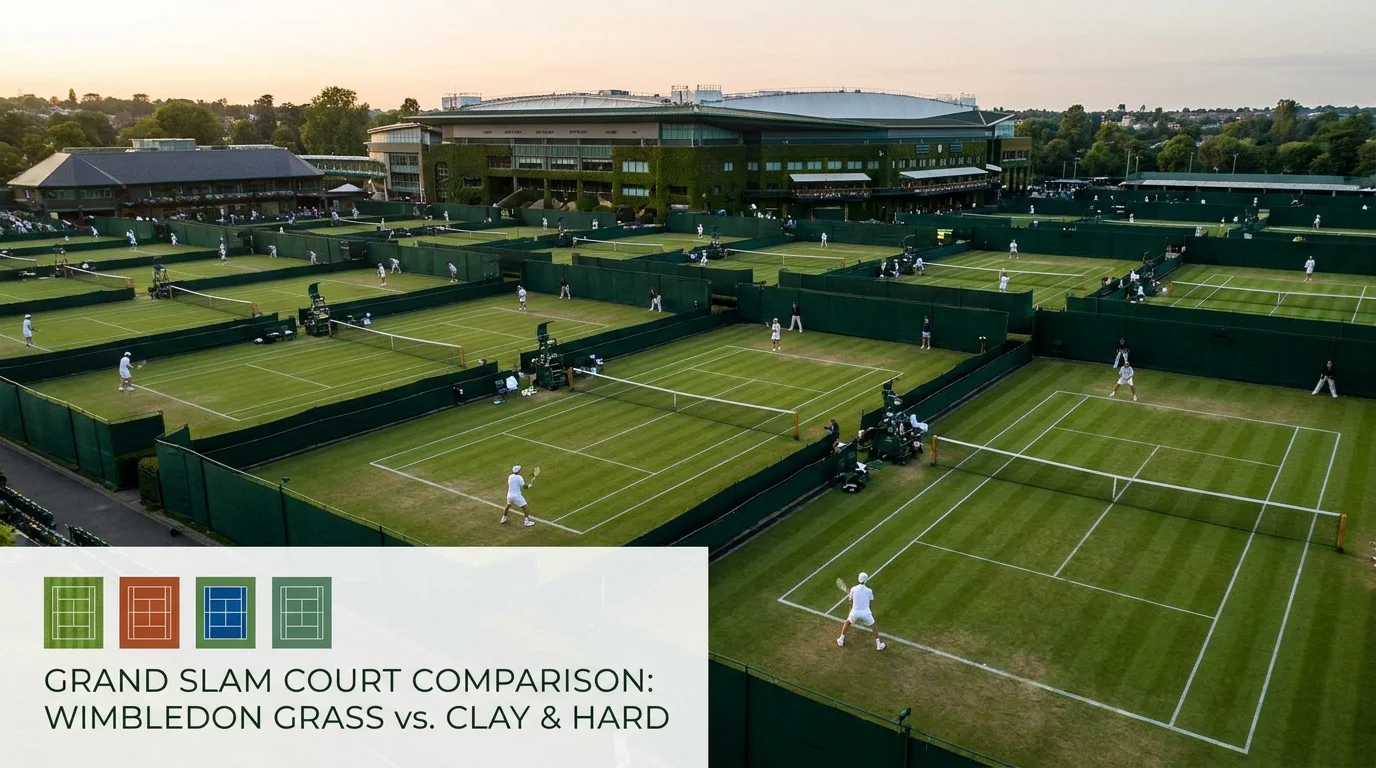
The two-week format creates a distinctive betting rhythm. The first week runs from Monday through Sunday with all rounds from the first through to the third and fourth. Multiple courts are in action simultaneously — Centre Court, Court One, Court Two, and up to twenty further grass courts — which means the in-play bettor has continuous live action across most of the working day. A bettor who can commit attention to the tournament between roughly noon and 8pm during the first week has access to dozens of in-play opportunities per day, which no other Grand Slam matches in terms of sheer breadth of live market availability.
The second week narrows to the last sixteen and beyond, which concentrates attention and betting volume on fewer matches of individually higher stakes. The balance between first-week breadth and second-week intensity creates a natural two-speed betting experience that regular Wimbledon punters learn to navigate. First week: selective, value-focused in-play; second week: deeper research, longer-term positioning.
None of the other three Grand Slams is played in UK time and at a venue with this level of cultural resonance. The BBC’s commitment to coverage — Centre Court and Court One matches throughout the fortnight — means that UK bettors are watching live rather than following score services, which materially improves in-play betting quality by giving direct visual information about player condition, serve mechanics, and momentum shifts. That direct observational edge is not available in the same way at the US Open or Australian Open, where coverage gaps mean many UK bettors are following text updates rather than watching live.
For the full discussion of how grass-court dynamics specifically shape the value available at Wimbledon compared to other surfaces, the detailed analysis is at grass-court tennis betting strategy.
What Makes the Wimbledon Market Distinct in Practice
Consolidating the above: Wimbledon is the only grass-court major, which means its pricing must work with limited comparable form data. It has the highest commercial sponsorship profile of any Grand Slam, which drives operator competition and market depth. It is scheduled at the optimal time for UK in-play betting engagement, and it is broadcast live throughout the fortnight on free-to-air television in the UK, giving bettors the best possible observational position. These factors combine to make Wimbledon the most actively bet Grand Slam in the UK market — not merely the most culturally prominent.
The practical implication for bettors approaching Wimbledon after having bet other Grand Slams: expect more volatility in early-round markets than the Australian Open or US Open typically produce, particularly in the women’s draw. Expect stronger value in secondary markets compared to what Roland Garros offers the UK audience. And expect in-play to be your highest-value tool across the fortnight — the scheduling and broadcast alignment between Wimbledon and the UK betting market is genuinely unique among the four majors, and it creates an edge that punters who prepare for live betting will consistently exploit.

Articles




Written by the editors at bettingonwimbledontennis.
