
Wimbledon Betting Tips: Building a Form Assessment That Actually Works
 Available in US
Player form is the number-one factor cited by 37% of UK bettors when deciding how to approach Wimbledon — ahead of intuition (19%), grass-court statistics (12%), and head-to-head records (10%). That ranking broadly reflects what the data shows: a player’s recent results are genuinely the most predictive single factor for Wimbledon outcomes, particularly in the early rounds where draw-quality differences are smallest. But “form” as most tipsters use the term is too imprecise to be useful. A player who has won 15 of his last 18 matches across clay and hard courts is not necessarily in better Wimbledon form than a player who has won 8 of his last 10 on grass specifically. The surface distinction is everything.
After nine years building and testing form models for Wimbledon specifically, my view is that the single biggest source of mispricing in the tipster market is the conflation of general form with grass-specific form. Correcting that conflation — methodically, using the right data sources — is where the edge is.
Why Player Form Outweighs ATP Ranking for Wimbledon Tips
The ATP ranking is a points-based system that accumulates over a rolling 52-week window, weighted by tournament category. It is a reasonably accurate measure of consistency across all surfaces and conditions. It is a significantly less accurate measure of grass-court ability specifically, because the grass season is short — six to eight weeks per year — and the points available from grass events are proportionally smaller than from clay or hard-court Masters events.
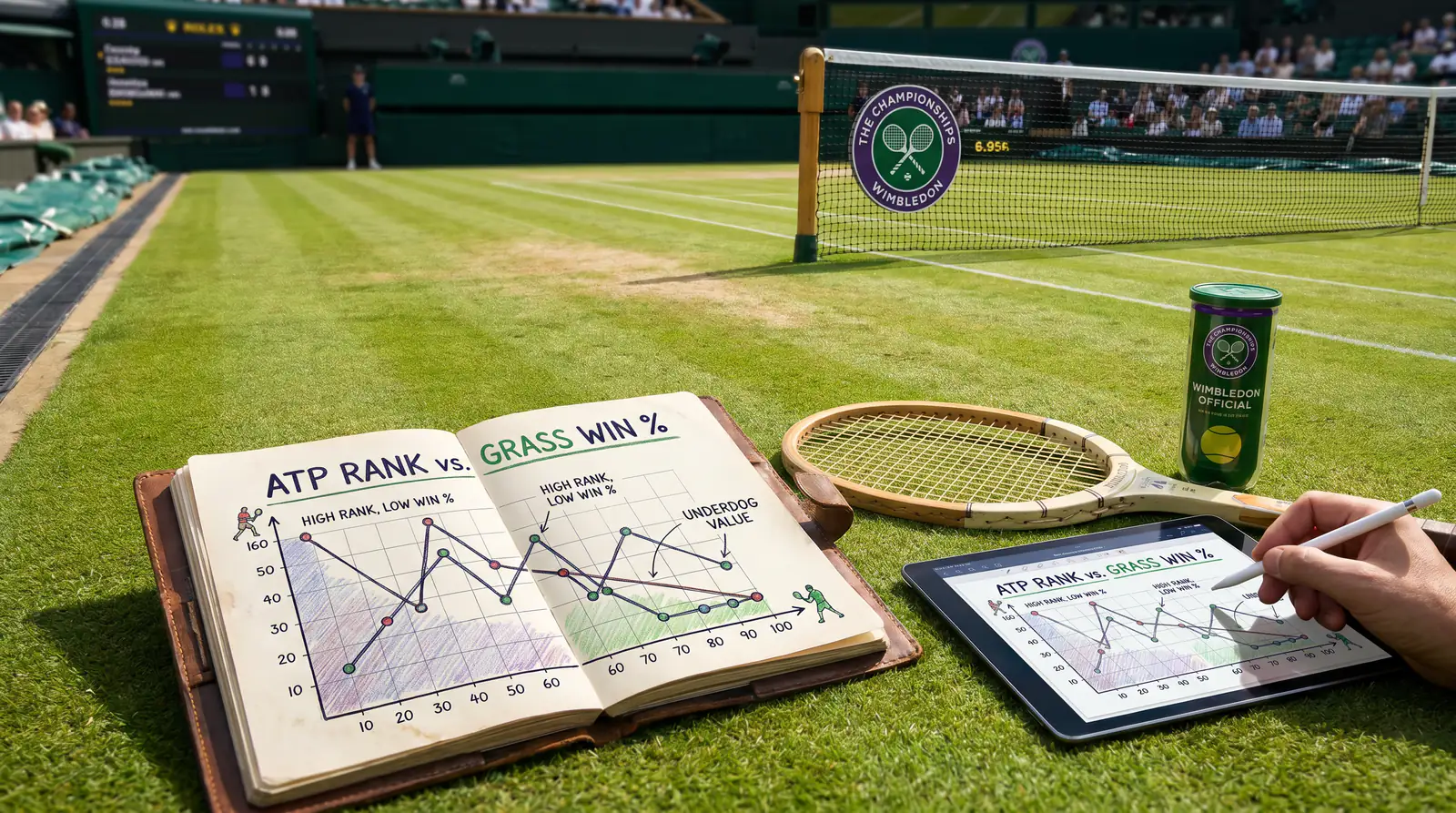
The result is that the ATP rankings going into Wimbledon contain substantial “surface contamination” — a player whose ranking reflects largely his clay-court performance may be seeded above a player whose ranking is lower primarily because he plays a more limited schedule that happens to concentrate on grass and hard. The bookmaker pricing inherits this distortion from the seedings and from the casual punter preference for backing high-ranked names. The gap between ATP ranking and grass-court reality is wider at Wimbledon than at any other Slam, and it persists because it is structural rather than accidental.
The practical implication: a player ranked 28th in the world with a grass win percentage of 68% over the past 18 months is a materially better Wimbledon prospect than a player ranked 14th with a grass win percentage of 51%. The rankings say one thing; the surface data says something different. The market, led by the rankings, will price the latter more favourably. The analyst who has built the grass-specific model will price the former more correctly.
Seven Data Sources UK Tipsters Use Before Wimbledon
Among the 13% of UK sports bettors who plan to wager on Wimbledon, the most successful approach consistently involves multiple independent data sources rather than relying on any single metric. Here are the seven sources I use and consider genuinely informative.

Grass win-loss record over 18 months, available from the ATP or WTA statistical databases. This is the foundation. Anything less than 18 months is too small a sample; anything more than 36 months begins to capture a player’s career form rather than current capability.
Serve statistics on grass specifically: first-serve percentage in, first-serve points won, aces-per-match, and double-fault rate. These are available from the Match Stats section of the ATP and WTA databases and from specialist tennis analytics services. On grass, first-serve points won above 75% is the benchmark for an elite grass server.
Return statistics on grass: return points won percentage. Grass courts produce the lowest return points won percentages of any surface, and a player whose return game improves specifically on grass (as distinct from their hard-court return game) is a player who can break serve reliably enough to win tight matches.
Queen’s Club and Halle results — specifically match scores, not just outcomes. A player who wins Queen’s in three comfortable sets has demonstrated different form than one who wins in three sets that included two tie-breaks. The former is playing with authority; the latter may be grinding through matches that will leave him physically compromised heading into Wimbledon fortnight.
Eastbourne, Birmingham, and Bad Homburg results for women. These events provide the most current grass data for the women’s draw and are underweighted by most tipster platforms that focus heavily on the men’s game.
Injury intelligence from press conferences and practice court observations. Injury tracking is imprecise and sometimes deliberately opaque, but persistent reports of a player protecting a limb in practice, or managing a physical issue publicly announced, are meaningful inputs. A player at 6/1 with a known wrist concern is not the same player as the same man at 6/1 in full health.
Historical performance at Wimbledon specifically. Some players have a psychological affinity for SW19 that their grass win percentage on other courts does not fully capture — a preference for the specific bounce, the specific crowd atmosphere, the specific conditions under the retractable Centre Court roof. This is harder to quantify but is visible in players who consistently outperform their form guides at this specific tournament.
What Wimbledon Tipsters Get Wrong — and How to Avoid It
The most common error in pre-Wimbledon tipster analysis is recency bias applied to the wrong surface. A player who had a spectacular clay-court spring — reaching the Roland Garros semi-finals, winning three Masters events — arrives at Wimbledon surrounded by momentum narrative. The press builds the story; the bookmakers react by shortening his price; recreational punters pile in. What nobody adequately weights is whether this specific clay-court form translates to grass. Often it does not, because the two surfaces reward different skill sets.

The second error is ignoring the draw structure in favour of pure player analysis. A player who might reach the Wimbledon semi-finals from one quarter of the draw might be a quarter-final exit from another quarter where they face a grass specialist in round four. Form analysis divorced from draw analysis is incomplete.
The third error — and this one costs real money — is backing players whose form looks excellent but who are playing their first significant grass events in two or three years after injury or scheduling changes. Returning players on grass need time to rediscover their feel for the surface. A player whose last competitive grass match before this Wimbledon was 18 months ago is not in “grass form,” regardless of how well he played on clay or hard court in the interim.
Building Your Own Wimbledon Form Model in 30 Minutes
The process I use is not technically complex. It requires a spreadsheet and access to ATP or WTA statistical databases, both of which are free. For each player I am considering, I record five metrics: grass win percentage (18 months), first-serve points won on grass (season average), return points won on grass (season average), warm-up event result (Queen’s/Halle for men; Eastbourne/Birmingham for women), and injury status. I standardise each metric to a 0-10 scale using the distribution of all players in the relevant draw, then calculate a weighted average with the following weights: 30% grass win percentage, 25% first-serve stats, 20% return stats, 15% warm-up event result, 10% injury status.
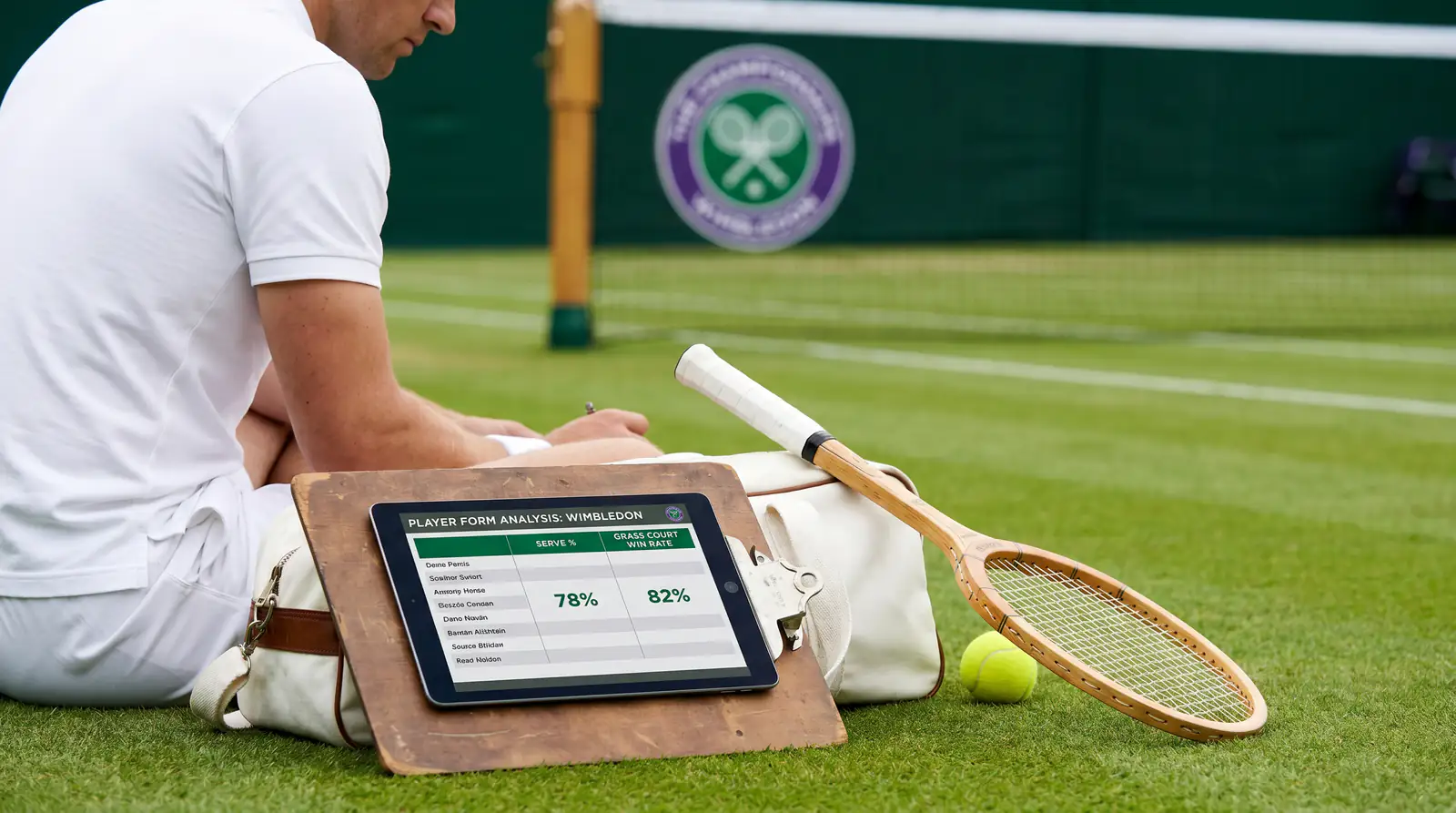

The resulting score is not a prediction — it is a baseline assessment of grass-court readiness. I then compare that score against the market’s implied probability for each player. When the score-implied probability and the market-implied probability diverge significantly, I investigate why. Sometimes the market knows something I have not captured. Sometimes the market is pricing in narrative rather than data, and the divergence represents value.
For the full strategic framework behind this kind of analysis, including how surface statistics interact with head-to-head records and draw position, the deeper guide is available at grass court tennis betting strategy.
Frequently Asked Questions
Articles


Written by the editors at bettingonwimbledontennis.
