
AI Predictions and Wimbledon Betting: Useful Signal or Overrated Hype?
 Available in US
Every summer before Wimbledon, a new wave of AI prediction tools appears promising to tell you who will win the title. Some of these tools are genuinely sophisticated. Most are not. And even the sophisticated ones have a specific structural problem with Wimbledon that makes their outputs less reliable than their interfaces suggest. The most experienced Wimbledon bettors still cite player form as their number one input — used by 37% as their primary factor — with grass-court statistics second and head-to-head records third. AI tools occupy none of those top spots in actual bettor behaviour, for reasons that are worth understanding in detail before you decide how much weight to give algorithmic outputs in your own process.
How AI Wimbledon Prediction Tools Work
The AI prediction tools you encounter before Wimbledon range enormously in their technical sophistication, and it is worth understanding the difference before evaluating any output they produce.

At the simple end are tools that are essentially weighted averages dressed in algorithmic language. They take ATP or WTA rankings, possibly combine them with recent match results, and produce win probabilities that closely mirror what any competent betting analyst could calculate manually in twenty minutes. The “AI” label is largely marketing — the predictions these tools produce are often no better calibrated than a reasonable human assessment, and the interface rarely makes the methodology transparent enough to evaluate.
More sophisticated tools — typically developed by sports analytics firms or academic research groups — use machine learning models trained on historical match data. These models identify patterns across thousands of matches: which variables most consistently predict outcomes, how those variables interact with specific surface conditions, and how player performance trajectories behave as a function of age, ranking trajectory, and physical condition. ELO rating systems, which track a player’s strength based on the quality of opponents beaten, are often incorporated as a base layer because they are demonstrably more predictive than raw rankings across all surfaces.
Monte Carlo simulation is a common approach at the high end: the model runs thousands of simulated tournaments, each using the underlying match win probabilities, and reports the percentage of simulations won by each player as their implied title probability. A player who wins 18% of 10,000 simulations is assigned an 18% outright probability. The mathematical architecture is sound. The question — always the question with these tools — is whether the underlying per-match win probabilities are accurate, and on grass at Wimbledon specifically, that is where the problems begin.
What UK Punters Think About AI in Tennis Betting
The public is not uniformly convinced by AI predictions, and the data from the most comprehensive UK survey on the subject is stark. Jake Ashmin, a sports and entertainment betting expert at OLBG, noted that 50% of UK tennis fans do not trust AI to predict tennis results, with a further 42% expressing concern about the broader role of AI in the sport. These are large proportions. Half the betting audience has already formed a sceptical view of AI prediction tools before they open any specific application.

That scepticism is not irrational. It reflects several things: the visible failure of high-confidence AI predictions in recent years (tools that were publicly wrong about obvious outcomes in memorable ways), the intuitive understanding that tennis is a sport where psychology and physical condition on a given day carry enormous weight that no historical model fully captures, and the general distrust of opaque systems that produce outputs without explaining their reasoning.
What the survey data also shows, however, is that the scepticism is not uniform across betting behaviour. The 13% of sports bettors who plan to bet on Wimbledon in 2026 include a subset who are sophisticated statistical thinkers — people who use data-driven tools as one input among several, not as a final answer. This group is not dismissing AI; they are integrating it correctly. The bifurcation in the market is between users who follow AI tips uncritically and those who use AI outputs as one evidence source among many. The second group tends to produce better outcomes over time.
Where Algorithmic Tools Genuinely Help Wimbledon Bettors
There are specific, bounded applications where algorithmic tools add real value to Wimbledon betting preparation, and it is worth being precise about what those applications are.

Historical pattern analysis — which player types have over or underperformed their ATP/WTA rankings at Wimbledon across the last ten or fifteen years — is where machine learning genuinely outperforms human memory. A model can identify that, say, left-handed serve-and-volley players with grass-court win rates above 65% have outperformed their seeding position in the last-16 at a statistically significant rate, without the analyst needing to remember every specific instance. Human pattern recognition is prone to availability bias — we remember the dramatic examples more vividly than the base rates. A well-trained historical model is immune to that bias.
Surface-adjusted ELO calculations are another area where algorithmic tools add genuine value. A player’s grass-court ELO rating — updated across every grass match they have played, weighted by the quality of opponent — is a better predictor of their Wimbledon match win probability than their current ATP ranking, which is surface-agnostic. Several free tools now calculate grass-specific ELO ratings, and the effort of looking them up before placing an ante-post bet is well repaid in the quality of information gained.
Injury and fatigue modelling is a newer application where AI tools are improving but not yet reliable. Some platforms incorporate data about match load across the season, travel distances, clay-court schedule intensity before the grass swing, and physiological benchmarks to estimate a player’s physical condition entering Wimbledon. The data quality is inconsistent — players do not publicly report their physical state accurately — but the framework is sound and worth monitoring as an additional factor when it flags a meaningful concern.
Where AI Predictions Break Down on Grass
The structural problem with AI predictions at Wimbledon comes down to data sparsity. Machine learning models improve with the volume and quality of training data. Wimbledon provides both in limited amounts.
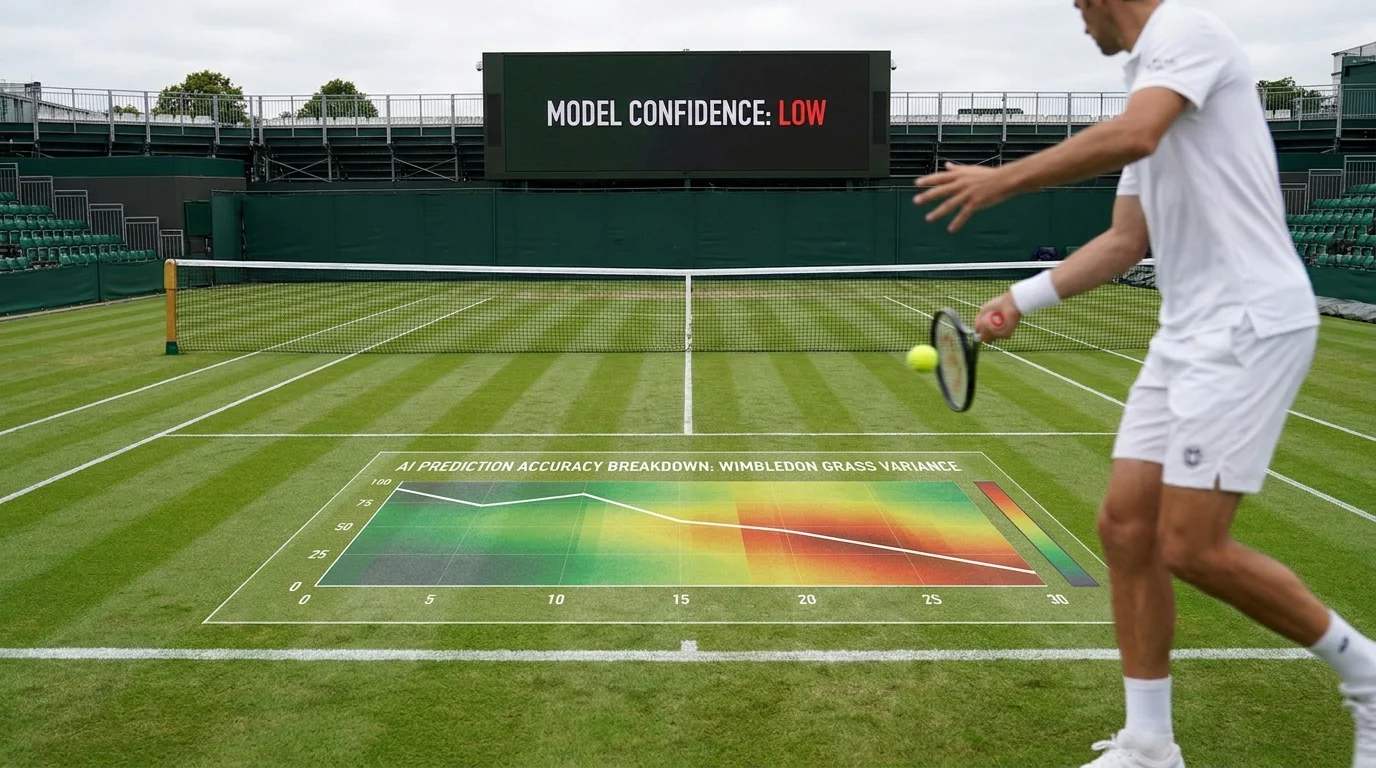
Every player in the draw has a grass-court record that spans, at most, a few weeks per year: Queen’s Club, Halle, possibly Eastbourne or ‘s-Hertogenbosch, then Wimbledon itself. A player in their eighth year on the professional circuit has perhaps forty to sixty grass-court matches in their career historical record. Compare this to their hard-court record — potentially three hundred or more matches across indoor and outdoor hard surfaces — and the fundamental limitation becomes clear. A model trained on forty matches per player cannot achieve the predictive reliability that a model trained on three hundred matches can, regardless of how sophisticated the algorithm is.
Grass-court specific conditions compound this. Court pace varies even within Wimbledon — inner courts are faster early in the tournament, outer courts play differently after rain. Ball condition changes across the fortnight as courts wear. These micro-variables affect match outcomes but are absent from historical databases because they are not consistently recorded. A model that cannot see these variables simply cannot account for them.
Finally, there is the psychological dimension. Wimbledon carries more pressure than any other event in professional tennis — for British players especially, for former champions returning to defend, for players who have reached the final without winning and are again within sight of it. The psychological weight of SW19 creates performance deviations from statistical baselines that no historical model can reliably capture, because each player’s psychological response to Wimbledon’s specific pressure is individual and context-dependent.
The practical conclusion: use algorithmic tools for the data work they are genuinely good at — historical patterns, surface-adjusted ELO, player type analysis — and apply your own judgement for the current-form, physical condition, and psychological factors that no model handles well. The full strategy framework for integrating these inputs is covered in the guide to grass-court tennis betting strategy.
Articles


Written by the editors at bettingonwimbledontennis.
