
Wimbledon Betting Habits: What the 2025 YouGov Survey Reveals About UK Punters
 Available in US
I have spent nearly a decade forming opinions about how UK punters approach Wimbledon betting, mostly from watching markets move and talking to other bettors in the trade. Then the OLBG/YouGov survey of 2,180 UK adults landed in June 2025, and several of those opinions required revision. The headline: 13% of UK sports bettors plan to bet on Wimbledon, which is lower than Wimbledon’s cultural profile might suggest. But the detail is where it gets interesting — who those 13% are, what they use to decide, and how much they bet reveals a profile that is more sophisticated and more measured than the “flutter on the tennis” casual narrative would predict. Separately, 37% of UK adults said they planned to watch Wimbledon on television, which confirms the size of the engaged audience even among those who do not bet.
Who Bets on Wimbledon in the UK: Demographics and Frequencies
The gender breakdown of Wimbledon betting is one of the most striking data points in the survey: 15% of men versus 4% of women bet on sports in Q1 2025. That gap — more than three to one — holds broadly across sports betting generally, not just Wimbledon. It reflects structural differences in how sport is marketed to and consumed by different audience segments, and it has concrete implications for how the Wimbledon betting market is shaped.
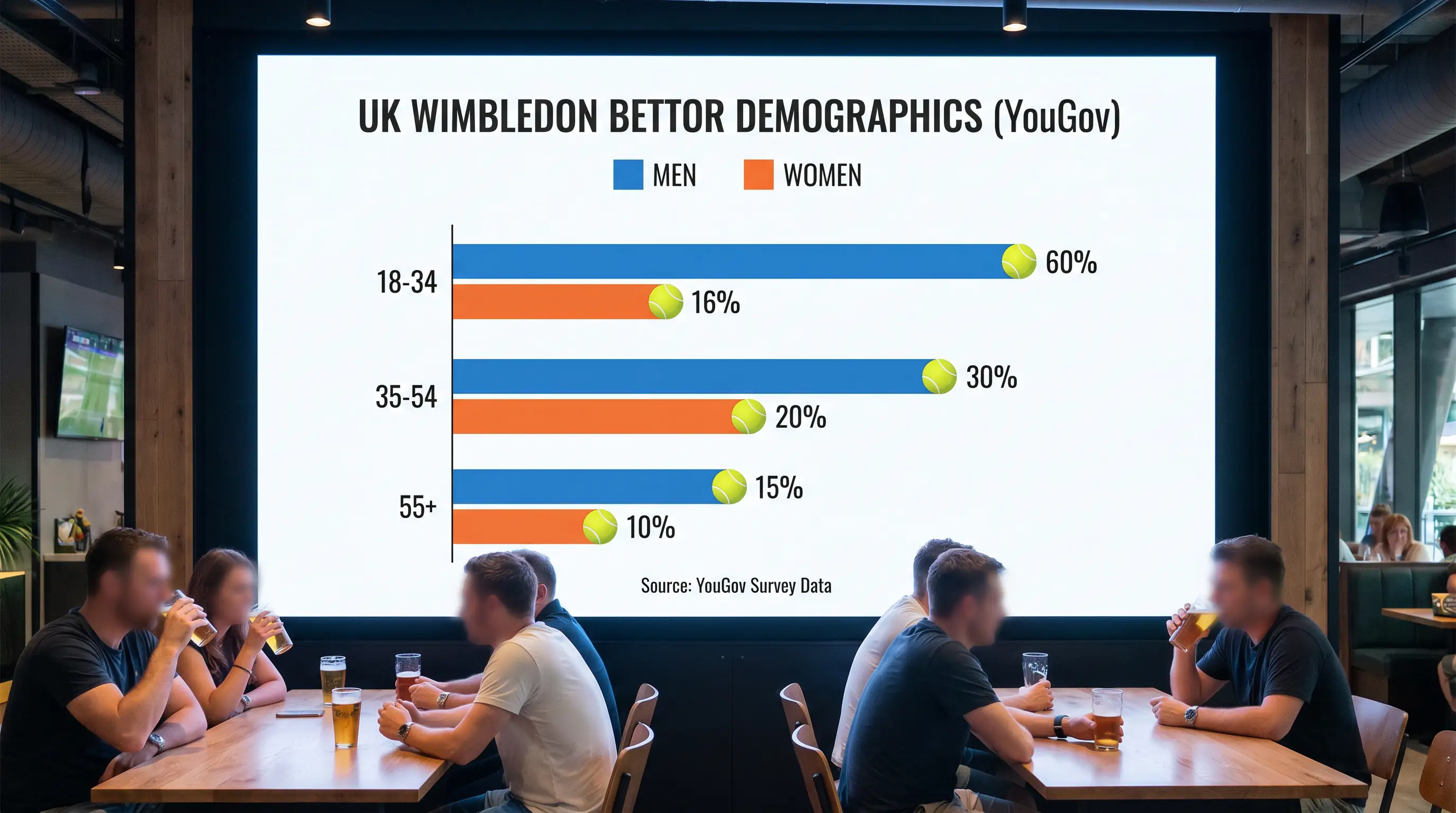
A male-dominated betting audience means that markets which are more popular with male viewers — historically the men’s singles, particularly in rounds featuring British players — tend to attract more attention and therefore tighter pricing than markets where the audience is more mixed. This is not a commentary on the merit of different markets; it is a statement about where the betting volume is concentrated and where, as a consequence, value is more or less available.
The frequency breakdown is equally revealing. Only 7% of UK bettors bet on tennis throughout the year. The large majority of the tennis-betting audience is seasonal — and a specific subset, 22%, bets exclusively on the four Grand Slam events. Wimbledon is the most prominent of those four in the UK, which means Wimbledon betting disproportionately attracts once-a-year participants who are not habitual sports bettors at all.
This seasonal composition of the Wimbledon betting audience has a direct market implication. Once-a-year bettors are, on aggregate, less price-sensitive and less strategically sophisticated than year-round punters. Their presence in the market helps sustain operator margins at higher levels than the average for sports betting — which means that for the subset of experienced punters engaging with the same markets, there is structural value available from the pricing inefficiency created by this casual majority.
Wimbledon Staking Habits: Typical Amounts and Patterns
The survey data on staking is precise in a way that is genuinely useful. Among those planning to bet on Wimbledon, 11% intend to stake between £5 and £50. Only 1% plan to stake more than £500 for the tournament as a whole. This distribution reflects the casual-majority composition of the audience: the predominant staking level is modest, consistent with entertainment betting rather than serious investment.

The practical implication for market shape: a betting audience concentrated in the £5 to £50 range does not move markets significantly on its own. Wimbledon outright prices and match odds are primarily set by professional traders and moved by larger professional money. The casual-majority participation creates turnover for operators without applying meaningful pressure on individual odds. This means the prices you observe at Wimbledon in the major markets — men’s and women’s outright, individual match winner — are primarily calibrated against sophisticated money rather than against public sentiment, which is the correct environment for analytical bettors.
There is one exception worth noting: in the domestic markets specifically — Jack Draper or other British players — public sentiment does create visible pricing pressure in the UK market. When a British player is performing well and attracting heavy casual money, their price can compress below the level that pure statistical analysis would justify. Identifying these moments — where public sentiment rather than analytical value is driving the price — is one of the consistent edge opportunities that experience produces at Wimbledon.
What Drives Wimbledon Betting Decisions: Form, Gut or Stats?
The decision-factor hierarchy from the survey is the most directly actionable data in the entire analysis. Among UK bettors who have previously wagered on Wimbledon: form is cited as the primary factor by 37%, intuition by 19%, grass-court statistics by 12%, and head-to-head records by 10%. The remaining responses are distributed across various secondary factors.

The 37% who use form correctly are doing the most important thing. Current form is the best single predictor of Wimbledon match outcomes that a non-professional bettor can assess, because it integrates recent physical condition, current serve mechanics, and confidence — factors that are difficult to disentangle individually but that combine into observable performance patterns. If a player is winning matches cleanly, serving at a high first-serve percentage, and managing their game efficiently at Queen’s Club, that form signature translates to Wimbledon more reliably than any single statistic.
The 19% who use intuition are the segment where market pricing is least efficient. Intuition-based betting tends to be biased toward familiar players, high seeds, and players who have performed memorably at Wimbledon in the past — none of which are reliable predictors of performance in any given year’s specific draw. The value opportunity that intuition creates is exploitable by anyone using the form-plus-data framework, because the intuition-heavy segment tends to overprice the obvious, narrative-friendly choices.
How Wimbledon Ranks Against Other UK Betting Events
In the 2026 UK betting events survey, Wimbledon ranked fifth at 11% of respondents intending to bet. This sits below the Grand National (51%), FIFA World Cup (43%), Cheltenham Festival (29%), and FA Cup Final (25%). The comparison is instructive rather than surprising: Wimbledon is a genuinely niche sport in UK betting terms, despite its cultural prominence.
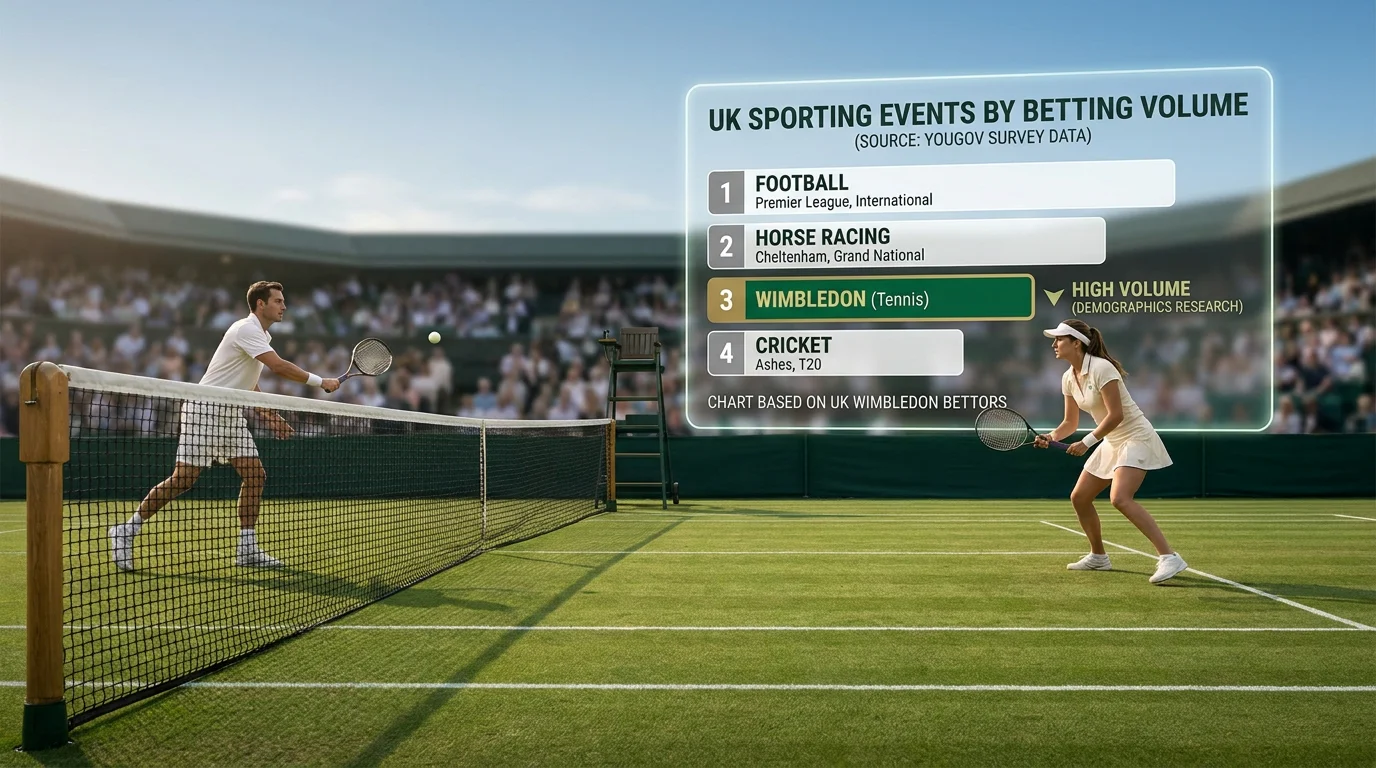
The betting footprint of Wimbledon is proportionate to tennis’s overall UK market share — not to its television audience or cultural prestige. The BBC’s peak audience of 7.5 million viewers for key Wimbledon matches demonstrates that the watching audience is enormous relative to the betting audience. This gap between watchers and bettors is larger for Wimbledon than for most other events in the top five, which partly explains why Wimbledon markets offer structural value that a more bet-heavy event like horse racing does not: the casual money is lower, the market is set against sharper inputs, and well-researched selections have a better chance of identifying genuine mispricing.
Richard Moffat, CEO of OLBG, summarised the dynamic well: “what stands out is the informed, statistically grounded approach” — the data shows Wimbledon bettors, despite being fewer in number than other sports bettors, tend toward a more deliberate methodology. That is the audience this guide is written for, and the regulatory context that governs how they bet is covered at UK gambling regulation and Wimbledon betting.

Articles



Written by the editors at bettingonwimbledontennis.
