
Wimbledon Set Betting: Correct Scores, Value Windows and Historical Hit Rates
 Available in US
Live in-play betting accounts for 62.35% of all online sports betting volume — but before any ball is struck, the set betting and correct set score markets offer some of the richest pre-match value at Wimbledon. These are also among the most misunderstood markets in tennis betting. The mechanics are straightforward, but the assessment of which correct set score to back — and when the prices are genuinely worth taking — requires a specific analytical framework that most punters never develop. The result is that these markets are simultaneously overused by casual bettors attracted by the appealing headline odds, and underused by serious analysts who can extract real value from them when applied correctly.
The distinction between set betting and correct set score betting is fundamental and is worth establishing clearly before anything else.
Set Betting at Wimbledon: Markets and Settlement Rules
Set betting is a market where you predict which player wins and in how many sets. In the men’s draw at Wimbledon, the options for the favourited player are 3-0, 3-1, and 3-2 (three sets to win). For the underdog to win, the options are 3-0, 3-1, and 3-2 in the underdog’s favour. In the women’s draw, it is a best-of-three format: 2-0 or 2-1 for either player.

Settlement in set betting is based on the final sets played, not on the score within each set. A 7-6, 7-6, 7-6 result and a 6-0, 6-0, 6-0 result both settle as “3-0 to the winner.” The scores within each set are irrelevant to set betting settlement — they matter only for game handicap or game totals markets.
Correct set score, by contrast, is a separate market where you predict the exact score in sets — for example, “Player A wins 7-6, 6-4” or “Player B wins 6-3, 7-6, 6-4.” This is the highest-margin market in tennis betting: operators typically carry overround of 12-18% on correct score markets compared to 3-6% on match betting. The prices are large and attractive, but the mathematical headwind is substantial.
The practical rule I use: set betting offers better value than correct set score for most Wimbledon matches. The additional precision of the correct set score comes at a cost — the overround eats more of the value — and is only worth targeting in specific situations where I have genuine edge in assessing the likely set-by-set outcome rather than the overall set count.
Correct Set Score Betting: Historical Hit Rates at Wimbledon
Player form is the primary consideration for 37% of UK bettors, but the most important variable in correct set score betting is not player form — it is the structural characteristics of the match. Two specific factors drive correct set score outcomes more reliably than any individual form metric.
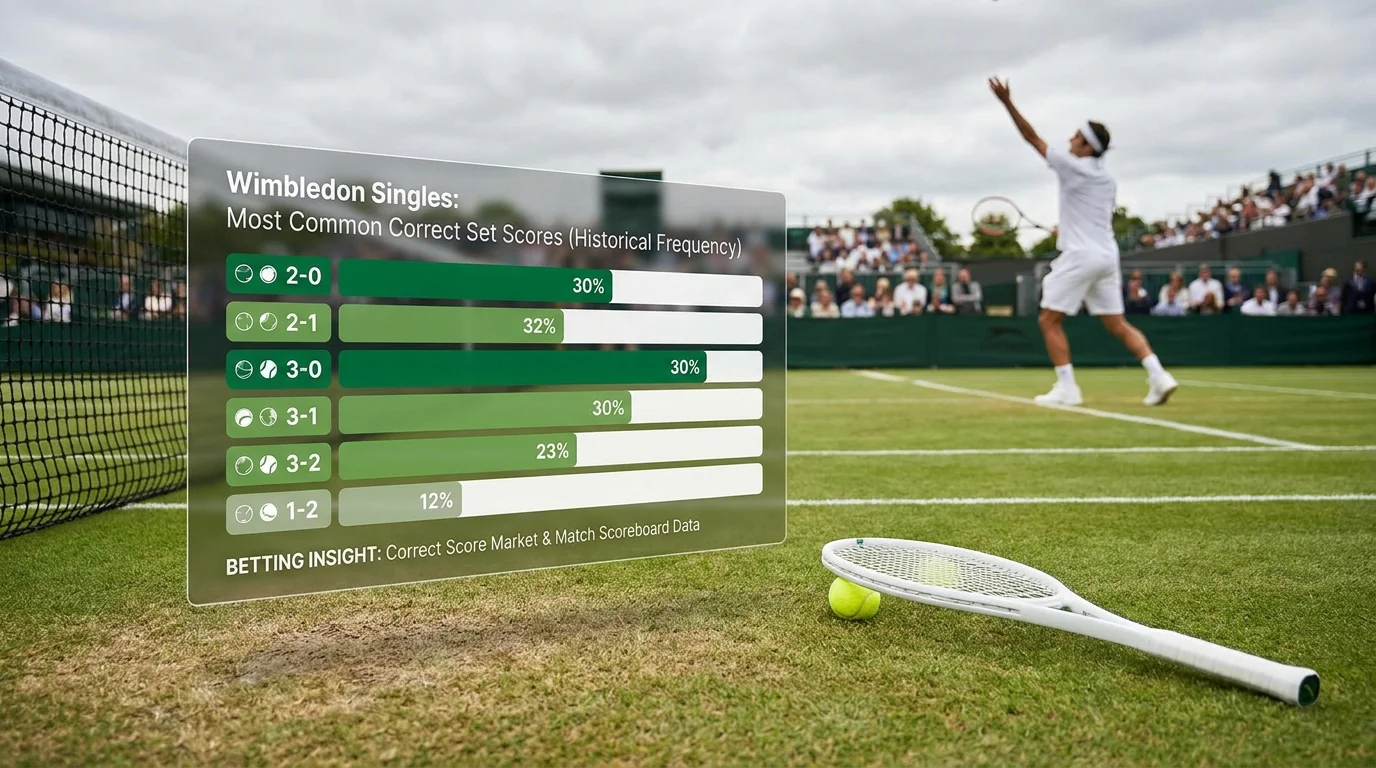
The first is the serve dominance differential. In the men’s draw on grass, a match where one player holds serve at above 85% of service games consistently tends to produce a 3-0 or 3-1 outcome — the dominant server wins relatively cleanly, without being pushed to a fifth set. A match where both players hold at similar rates and the match is likely to be decided in tie-breaks produces a 3-1 or 3-2 outcome more often. Identifying the correct scenario requires looking at both players’ first-serve statistics on grass specifically.
The second factor is round position and match importance. The highest frequency of 3-0 results in the men’s draw occurs in rounds one and two, where the quality gap between players is largest and the serve advantage is most dominant. As the tournament progresses to the quarter-finals and semi-finals, 3-2 results become substantially more common — roughly 35% of men’s Wimbledon semi-finals produce a five-set outcome, compared to approximately 20% of first-round matches.
For women’s tennis, the pattern is different because the best-of-three format eliminates the five-setter dynamic entirely. The most common correct score at women’s Wimbledon is 2-0, occurring in roughly 55-60% of matches based on recent tournament data. 2-1 results account for the remaining 40-45%. Within those broad categories, backing “2-0 to the favourite” in women’s matches where there is a significant ranking gap and clear grass-court capability difference is often correctly priced at around Evens to 11/10. Seeking additional precision — backing the exact scores within the 2-0 format — adds overround cost without commensurate edge for most analysts.
Men’s Five-Setter vs. Women’s Three-Setter: Set Betting Differences
The structural difference between men’s and women’s set betting at Wimbledon creates fundamentally different value profiles in the two draws. The men’s five-set format produces a more complex outcome space: six possible results in full (3-0, 3-1, 3-2 for either player). The women’s three-set format reduces this to four possible outcomes. More possibilities with the same total overround distributed across them means individual outcomes can be more attractively priced in the men’s draw — but also means the correct pricing of each individual set score is harder to assess.

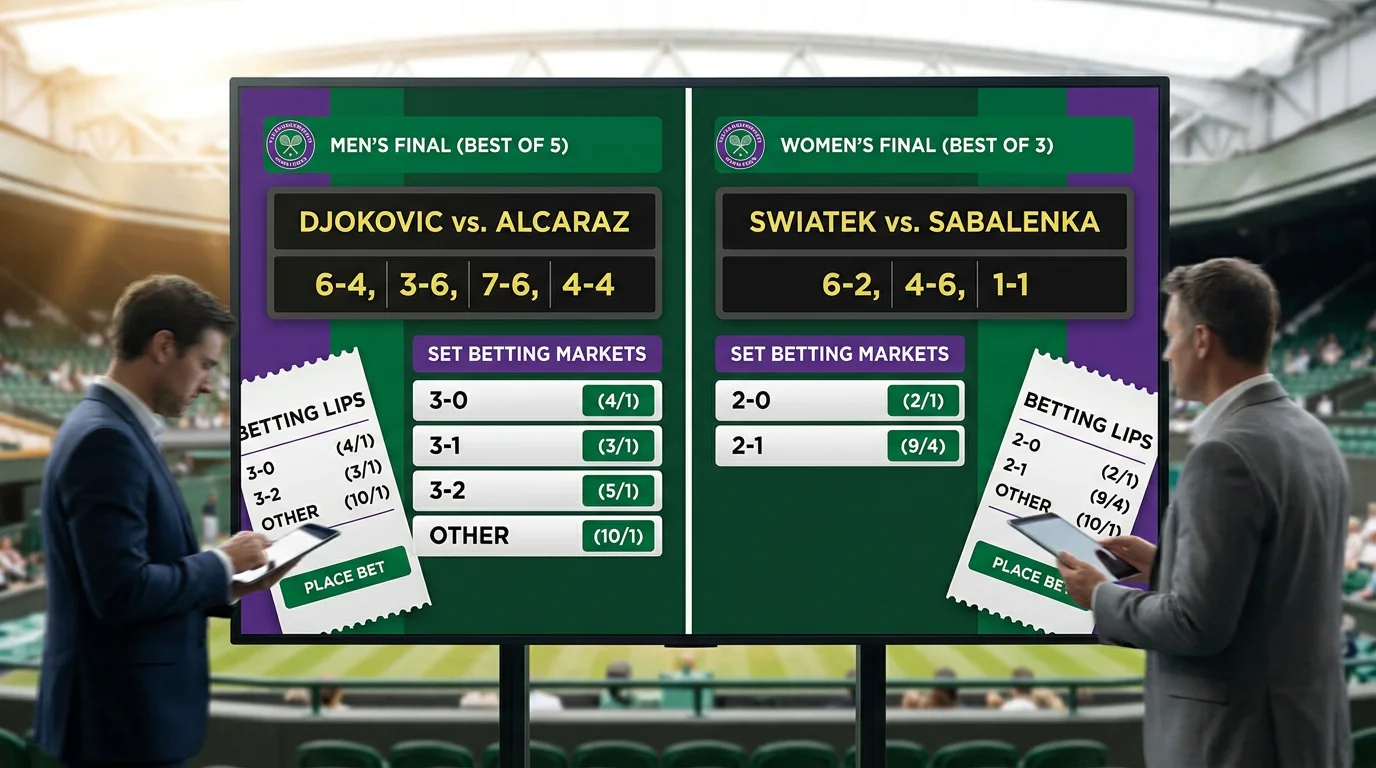
My general framework: in the men’s draw, set betting (rather than correct set score) on the favoured player to win by 3-0 is most valuable in rounds one through three for matches involving a top-eight seed with exceptional grass-court credentials against an opponent without a genuine grass record. In these scenarios, the 3-0 price tends to be in the 10/11 to 6/4 range, which is reasonable when the serving conditions favour dominance and the quality gap is real.
In the women’s draw, set betting is most valuable from the quarter-finals onwards, where both remaining players are established enough to push each other, making the “2-1” option more likely than the market’s implied probability suggests. Grass at Wimbledon can produce unexpected set losses even for dominant players — a bad service game here, a confident return game there — and the 2-1 in favour of the overall winner is consistently underpriced relative to historical frequency in the women’s second week.
As Unibet’s official 2025 guidance observed, “Wimbledon — the only grass Grand Slam — creates unique betting dynamics compared to other majors: fast serves, short rallies and unpredictable results make it ideal.” That unpredictability compresses the distinction between 3-0 and 3-1 in the men’s draw in ways that the market does not always capture precisely. For the full framework of how different markets compare in terms of overround and opportunity, see Wimbledon betting markets explained.

Frequently Asked Questions
Articles



Written by the editors at bettingonwimbledontennis.
